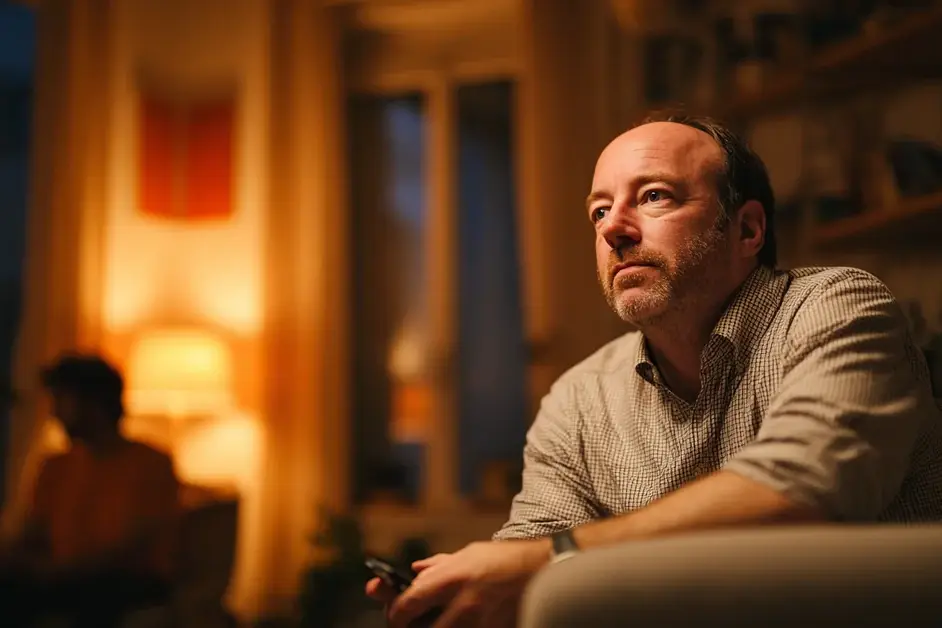
Therapist Insights / Executive Mental Health
Why successful people are the loneliest.
Loneliness is a subjective state: the gap between the connection you have and the connection you need. Social isolation is a headcount. Senior leaders tend to score well on the headcount and badly on the gap, because the role fills a calendar with people who cannot be told the truth. This is what that costs, and what changes it.

THE QUICK TAKEAWAY
Loneliness and social isolation are two different measurements, and confusing them is why most advice aimed at successful people misses. Social isolation counts contacts and roles. Loneliness measures the distance between the relationships a person has and the ones they need. Senior leaders usually pass the first test and fail the second, because authority changes what can safely be said to almost everyone in the room. Success does not cause this. The conditions of senior roles, meaning asymmetry of power, scarcity of peers and the real cost of disclosure, are associated with fewer relationships in which candour is free.
§01 / 09 / Definition
Loneliness is not the same as isolation.
Loneliness is a subjective experience of lacking meaningful connection, while social isolation is an objective count of relationships, roles and interactions. Senior leaders and high achievers are rarely isolated by that count and frequently lonely by that experience, which is why advice built on the count keeps missing them.
Two words get used interchangeably in almost everything written about this, and the confusion is not harmless. Social isolation is a count. It asks how many people you see, how many roles you hold, how often you interact, and it can be answered by an observer with access to your calendar. Loneliness is a judgment you make about the relationships you already have. The U.S. Surgeon General's 2023 advisory defines loneliness as a subjective distressing experience that results from perceived isolation or inadequate meaningful connections, and defines social isolation separately as objectively having few social relationships, social roles, group memberships and infrequent social interaction. A senior leader usually scores well on the second measure and badly on the first. Sixty people said your name this week. Eleven of them wanted something you control. Nine report to you. Four are on the other side of a deal. Not one of them could be told that you have been awake since three in the morning wondering whether you are still any good at this. The National Institute on Aging states the paradox in a single line: you can live alone and not feel lonely or socially isolated, and you can feel lonely while being with other people. The Centers for Disease Control and Prevention puts it more bluntly, noting that even a person with a lot of friends can feel lonely. That distinction carries the rest of this article, and it explains why the standard advice fails the people it is aimed at. Telling a chief executive to get out more prescribes a treatment for a condition they do not have. Their contact count is fine. What has thinned is the number of those contacts in which honesty costs nothing, and in senior roles that number drifts toward zero without anybody deciding that it should.
Five conditions of the senior role that narrow the circle
Asymmetry of power
Almost everyone in the room reports to you, sells to you, or wants something you control. A relationship with a power gradient running through it can be warm, respectful and genuinely affectionate, and still not be a place where you can say out loud that you are frightened.
The real cost of disclosure
Candour early in a career costs embarrassment. Candour in a senior seat can unsettle a team, move a valuation, start a succession conversation you did not want, or turn up in a deposition. Leaders learn to price that cost accurately, and then they pay it by saying less.
Scarcity of true peers
The number of people holding a comparable seat, in a comparable sector, with no competing interest and no reason to repeat it, is genuinely small. Peer groups and forums exist to solve this and often help, but the pool is thin and it thins further the higher the seat sits.
Time the role has already spent
The decade that builds a career is the same decade that builds friendships, and the role takes it. The Surgeon General's advisory records that in-person time with friends in the United States fell from roughly sixty minutes a day in 2003 to roughly twenty minutes a day in 2020, a national trend that a demanding seat accelerates rather than resists.
Composure that has become automatic
Twenty years of being rewarded for steadiness turns steadiness into a reflex. Many senior leaders arrive unable to answer the question how are you with anything other than a status update, not because they are concealing something, but because the honest answer has been out of use long enough to be genuinely hard to locate.
▶ Research
The U.S. Surgeon General's 2023 advisory, Our Epidemic of Loneliness and Isolation, reports that loneliness and social isolation increase the risk for premature death by 26 percent and 29 percent respectively, drawing on a 2015 meta-analytic review published in Perspectives on Psychological Science. Read what those two numbers actually are: separate estimates for two separate constructs, measured in different ways. Nothing in that literature says success causes either one, and nobody should say it does. What the evidence does establish is that the subjective side, the loneliness itself, carries measurable risk even when the objective headcount looks entirely unremarkable, which is the exact position a great many senior leaders occupy.1
What the gap is doing while you work
The body registers it before you do
The Surgeon General's advisory associates poor social relationships with a 29 percent increased risk of heart disease and a 32 percent increased risk of stroke, and links chronic loneliness and social isolation to a roughly 50 percent increased risk of dementia in older adults. Those are population-level associations across whole populations, not predictions about any individual leader, and they are still a reason to stop treating this as a mood.
Judgment degrades in a way that is hard to see from inside
Decisions made with no one to test them against tend to get made twice: once at the desk and once again at four in the morning. That second pass consumes the reserve that the next day's decisions were supposed to run on, which is why isolation and depletion so often arrive together. Clinical work for people who decide for a living targets that loop specifically.
Competence keeps working, which is the problem
The performance holds. Numbers land, the board is satisfied, and nobody outside the house sees anything wrong. High achievers are unusually good at this, and it delays help by years, because the internal evidence and the external evidence point in opposite directions. It is also precisely how anxiety shows up in people who never miss a deadline.
Who carries this with you
Loneliness at the top is rarely contained inside the person holding the seat. The load redistributes itself onto whoever is nearest, usually without anyone naming what is happening, which is one reason therapy for leadership isolation so often begins with a conversation about other people rather than about the leader.
Your leadership team
A leader who has nowhere to put the pressure tends to put it into the room instead. It shows up as a shorter fuse in a meeting, as decisions held too close, or as a strange formality that people read as disapproval. None of it is deliberate, and all of it is visible.
Your spouse or partner
When one relationship is doing the work that five or six relationships used to do, the strain lands there. A partner becomes therapist, board, confessor and only witness at once, and the marriage quietly starts carrying a load it was never designed to hold. That imbalance is treatable in its own right, and couples work often addresses it more directly than individual sessions can.
The friendships that went quiet
Almost nobody ends these deliberately. Calls get returned later, then not at all, and after a few years the reasonable-sounding explanation is that you have grown apart. The Surgeon General's advisory records that 49 percent of Americans in 2021 reported having three or fewer close friends, against 27 percent in 1990.
§02 / 09 / Telehealth
What therapy actually changes here.
Therapy gives a senior leader one relationship with no reporting line, no equity position and no cost attached to candour. CEREVITY clinicians treat leadership isolation as a structural feature of the role rather than a character defect, which is why the work usually starts with what cannot be said anywhere else.
One relationship with nothing riding on the answer
Your clinician does not own shares, does not sit on the board, does not report to you and will not be in the room when the decision is announced. That is not a small technicality. Loneliness at senior levels is maintained by the accurate perception that every listener has a stake. Removing the stake removes the reason to edit.
A check on a reading of the room that may be out of date
Some of the caution is correct and some of it has calcified. A leader who once had a disclosure used against them frequently generalizes the lesson to every relationship they will ever have. Sorting the accurate reading from the reflex is ordinary clinical work, and it usually returns more people to the circle than the leader expected.
Symptoms get named rather than absorbed
Chronic loneliness rarely arrives labelled. It arrives as broken sleep, as irritability that surprises you, as a flatness that no result touches, as a drink that has moved earlier in the evening. Naming those as symptoms rather than as personal failings is often the first thing that changes, and it is what makes them treatable.
§03 / 09 / Mechanism
Why fit decides whether this works.
Fit matters more for loneliness at senior levels than for almost any other presenting problem, because the pattern is maintained by an accurate reading of who can be told what. Senior leaders who edit themselves for a clinician who does not understand the stakes simply reproduce, in the room, the thing that brought them there.
Most therapy is designed around a different life. The forms assume a different set of constraints, and the first several sessions can disappear into explaining what a board actually does, why a quiet quarter is not a small thing, or what it means that four hundred people's jobs sit downstream of a decision you have not made yet. None of that is anyone's fault. It is still a bad use of the scarcest resource the person in the chair has, and it teaches the leader that this room is one more place where they have to manage the listener.
It also changes what gets said. A leader who senses that the clinician is impressed, or intimidated, or quietly disapproving of the scale of the thing, will start curating. They will present the tidier version, minimize, and land on a conclusion before the session ends because landing on conclusions is what they are paid for. CEREVITY is a nationwide network of independent licensed clinicians who work routinely with people in senior seats, which is why confidential therapy for chief executives is built around fluency in the world rather than around curiosity about it.
Fit is not a comfort here, it is the mechanism. The whole treatment depends on producing one relationship in which the usual calculation does not apply, and that cannot happen if the leader is still doing the calculation. Different professions carry different versions of the same constraint: a managing partner cannot speak freely to associates who will vote on compensation, and therapy for attorneys is shaped around privilege, precedent and a professional culture where admitting strain is read as a liability. The specifics differ. The structure does not.
► Standard advice vs. CEREVITY's approach
Standard therapy
"Be told to get out more and make new friends"
CEREVITY
"Treat the gap between contact and candour, which is the actual measure"
Standard therapy
"Spend the first month explaining what your job involves"
CEREVITY
"Start with a clinician who already understands the seat"
Standard therapy
"Ask the one person at home to absorb all of it"
CEREVITY
"Redistribute the load so no single relationship carries the whole weight"
| Standard insurance-based therapy | CEREVITY's specialized approach |
|---|---|
| "Be told to get out more and make new friends" | "Treat the gap between contact and candour, which is the actual measure" |
| "Spend the first month explaining what your job involves" | "Start with a clinician who already understands the seat" |
| "Ask the one person at home to absorb all of it" | "Redistribute the load so no single relationship carries the whole weight" |
A break from the page
The circle can be widened. It usually is.
A first conversation is confidential and commits you to nothing. CEREVITY is a nationwide network of independent licensed clinicians working entirely private-pay, with no insurance claim submitted and no diagnosis on a payer record. If you have run out of people you can be honest with, start with a private inquiry.
§04 / 09 / Cases
Common challenges we address.
The founder whose company grew past their friendships
The patternSomeone who was one of six people in a room eight years ago and now employs three hundred. The people who knew them before the outcome have drifted, partly through time and partly through a wealth and status gap nobody will discuss. New relationships form quickly and are all transactional in some direction. The loneliness is specific: not a shortage of people, a shortage of people who knew them before it worked.
What we addressThe work separates the friendships that ended from the friendships that were merely neglected, which is usually a larger category than the founder believes. It also treats what has accumulated underneath, because founders in this position often arrive with exhaustion that has stopped responding to time off, which is the territory of burnout care built for people who cannot step away.
The leader whose only confidant is at home
The patternA person with exactly one honest relationship, usually a spouse, and a growing awareness that the relationship is buckling under it. Evenings become debriefs. The partner knows every name in the org chart and has opinions about all of them. Resentment builds on both sides and neither person can say so, because the alternative to this arrangement appears to be nobody at all.
What we addressThe first move is not to take anything away from that relationship but to stop it being the only one. Therapy adds a second channel with no domestic consequences attached, and the marriage gets to be a marriage again. Where the imbalance has already done damage, the individual and relational work often run alongside each other rather than in sequence.
§05 / 09 / Methods
Evidence-based treatment approaches.
No single method treats loneliness, so CEREVITY clinicians select among cognitive behavioral therapy, acceptance and commitment therapy, interpersonal work, psychodynamic exploration and relational or group approaches, according to what is actually maintaining the gap for a given senior leader. Assessment comes before the approach is named.
Cognitive behavioral therapy
Targets the beliefs that keep the circle closed, which for senior leaders are usually beliefs about consequence rather than beliefs about worth. Nobody needs their self-esteem repaired here. What needs testing is the prediction that disclosure will be used, and the structured format allows those predictions to be checked against what actually happens rather than argued about.
Acceptance and commitment therapy
Works on the relationship to the discomfort rather than on eliminating it, using values and committed action as the frame. It suits leaders who already understand their situation perfectly well and are still stuck, because the intervention is behavioral rather than explanatory: it asks what a person is willing to do while the discomfort is still present.
Interpersonal work
Takes the relationships themselves as the material. Sessions map who is actually in the circle, what each relationship can and cannot hold, and where a role transition, a promotion, a move, a founding, quietly removed a set of connections that were never replaced. For loneliness specifically, this is often the most direct route.
Psychodynamic exploration
Looks at the older pattern underneath the current one. Some leaders were self-sufficient long before they were senior, and the seat rewarded a habit that was already there. Understanding where it started does not by itself change anything, but it frequently explains why the obvious solutions have not worked.
Relational and group approaches
Use the therapeutic relationship, or a facilitated group of comparable peers, as a live rehearsal rather than a discussion of one. For a person whose every professional interaction carries an angle, the experience of being in a room where nobody wants anything is itself the active ingredient, and it is difficult to arrange anywhere else.
§06 / 09 / Investment
Understanding the investment in private-pay care.
Private-pay, nationwide, and built around discretion
At CEREVITY, our online individual therapy sessions are structured as a direct investment in your mental agility and overall well-being. The investment includes:
- Licensed mental health professional specializing in confidential therapy for senior leaders
- Evidence-based, one-on-one approaches proven effective for loneliness, isolation, anxiety, and low mood
- Flexible online scheduling including evenings and weekends
- Complete privacy with no insurance involvement or red tape
- Senior leaders and high achievers expertise and understanding
- Outcome tracking and progress measurement
The cost of loneliness at the top going unaddressed
Consider what is at stake when loneliness at the top goes unaddressed:
What private-pay changes about this specific problem
Working outside of insurance means no claim, no diagnosis on a payer record, and no third party reviewing whether the care should continue. For a leader whose entire presenting problem is that disclosure carries a cost, that structure is not a preference, it is the treatment condition. View our current rates here.
Session formats that survive an executive calendar
Care is delivered by secure telehealth nationwide across all 50 states. Most of this work sits well in regular weekly appointments, which is the format that builds the relationship the treatment depends on. Where a single hour keeps ending in the middle of something, room for work an hour keeps interrupting makes more sense. For leaders whose calendars make weekly slots unrealistic for months at a time, the 3-hour intensive format covers ground that would otherwise take a season.
§07 / 09 / Evidence
What the research shows.
The population evidence on loneliness is strong, and it is worth being precise about what it does and does not say. A 2015 meta-analytic review in Perspectives on Psychological Science, examining studies published between 1980 and 2014, reported weighted average increases in the likelihood of mortality of 29 percent for social isolation, 26 percent for loneliness and 32 percent for living alone, and found the association to be more predictive of death in samples with an average age under 65. Those three figures are estimates for three different exposures, which is the whole point: the objective measure, the subjective measure and the household measure move separately and have to be handled separately. The U.S. Surgeon General's 2023 advisory carries the same two headline figures and adds cardiovascular and cognitive outcomes, while the Centers for Disease Control and Prevention reports that about one in three U.S. adults say they feel lonely and about one in four say they lack social and emotional support. In June 2025 the World Health Organization's Commission on Social Connection put the global figure at one in six people affected by loneliness, linked to an estimated 100 deaths every hour, more than 871,000 deaths a year.
► What the population evidence reports
increased risk of premature death associated with loneliness, the subjective measure.
U.S. Surgeon General's Advisory, 2023
increased risk of premature death associated with social isolation, the objective measure.
U.S. Surgeon General's Advisory, 2023
people worldwide are affected by loneliness, linked to more than 871,000 deaths a year.
World Health Organization, 2025
The evidence about senior leaders specifically is much thinner, and any article claiming otherwise is overreaching. The widely quoted statistic that half of chief executives report loneliness, of whom 61 percent believe it hinders their performance, originates in a consultancy survey rather than in a peer-reviewed study, and the primary report is no longer publicly retrievable, which is why it does not appear as a source here. A 2026 bibliometric review in Humanities and Social Sciences Communications, mapping the management literature on workplace loneliness, found that leadership-related keywords co-occur rather infrequently with core loneliness constructs and concluded that leadership has not yet been conceptualised as a relational process affecting workplace loneliness. So the honest position is this: loneliness is a well-measured health exposure at population scale, the conditions of senior roles are plainly associated with fewer relationships in which a person can be candid, and the claim that success causes loneliness is not something the research supports. Treatment does not require that claim. It requires only that the gap is real, and for a great many senior leaders it demonstrably is.
§§ / 09 / Recap
Key takeaways.
Five things to remember
- The two words measure different things Social isolation counts relationships. Loneliness measures the distance between what you have and what you need. Senior leaders usually pass the first and fail the second, and advice built on the first will keep missing.
- The role narrows the circle, not the achievement Asymmetry of power, scarcity of true peers and the genuine cost of disclosure are features of the seat. Naming them as structural is more useful, and more accurate, than treating loneliness as a personal shortcoming.
- The health risk is measurable at population scale Loneliness and social isolation carry increased risk of premature death of 26 percent and 29 percent respectively in the pooled evidence. Those are population associations rather than personal forecasts, and they are still reason enough to treat this seriously.
- One relationship with no stake in the answer changes the arithmetic Therapy is not a substitute for friendship. What it supplies is the missing condition, a listener with nothing riding on what you say, which is usually what lets the rest of the circle start widening again.
- CEREVITY provides this through online individual therapy nationwide, with full privacy through its private-pay concierge network and no insurance involvement.
§08 / 09 / FAQ
Frequently asked questions.
Why does success feel lonely?
Success itself does not create loneliness, but the conditions that arrive with it are associated with fewer relationships in which a person can speak freely. Seniority produces asymmetry: nearly everyone in the room reports to you, sells to you, invests alongside you, or competes with you, and each of those relationships attaches a real cost to an unguarded sentence. Loneliness is defined as the gap between the connection a person has and the connection they need, so a fuller calendar and a narrower set of confidants can happen at the same time without contradiction. High achievers also tend to spend the years that build a career on the career, which shortens the list of friendships that predate the title. CEREVITY clinicians treat that gap as a clinical target rather than as an unavoidable tax on achievement.
Is loneliness the same thing as social isolation?
Loneliness and social isolation are related but genuinely distinct, and they are measured in different ways. The U.S. Surgeon General's 2023 advisory defines loneliness as a subjective distressing experience resulting from perceived isolation or inadequate meaningful connections, and defines social isolation as objectively having few social relationships, social roles, group memberships and infrequent social interaction. The National Institute on Aging states the practical consequence directly: you can live alone and not feel lonely or socially isolated, and you can feel lonely while being with other people. That second half is the one that matters for senior leaders, whose contact counts are high and whose confiding counts are not. Any screening question that only asks how many people you saw this week will miss the problem entirely.
Why do CEOs feel lonely?
Chief executives occupy the one seat where information stops flowing freely in both directions. Everything travelling upward has been shaped by someone with an interest in how it lands, and everything travelling downward is read for signals that were never intended. That leaves a person surrounded by communication and short of candour. Add the scarcity of comparable peers who are not also competitors, the possibility that a disclosure becomes a governance matter, and a professional culture that reads visible strain as a succession risk, and the arithmetic is not mysterious. Loneliness in that seat is a predictable consequence of its structure rather than evidence of a flaw in the person holding it, which is also why it responds to treatment aimed at the structure.
Is loneliness bad for your health?
Loneliness carries measurable health risk at population level. A 2015 meta-analytic review in Perspectives on Psychological Science reported increases in the likelihood of mortality of 26 percent for loneliness, 29 percent for social isolation and 32 percent for living alone. The U.S. Surgeon General's 2023 advisory carries those figures and adds a 29 percent increased risk of heart disease and a 32 percent increased risk of stroke associated with poor social relationships, along with a roughly 50 percent increased risk of dementia in older adults. Read those as associations across large populations rather than as forecasts for any individual. For senior leaders the practical implication is narrower and clearer: this is a health exposure with a treatment path, not a mood to be waited out.
Why is everyone so lonely right now?
Population data show the ground shifting underneath everyone, not only high achievers. The U.S. Surgeon General's 2023 advisory records that in-person time with friends in the United States fell from about sixty minutes a day in 2003 to about twenty minutes a day in 2020, and that 49 percent of Americans in 2021 reported having three or fewer close friends compared with 27 percent in 1990. The Centers for Disease Control and Prevention reports that about one in three U.S. adults feel lonely, and the World Health Organization put the global figure at one in six people in 2025. Senior leaders are subject to all of that plus a set of role-specific constraints on candour, which is why the same national trend lands harder on them.
I have a spouse, a team and a full calendar. Can I still be lonely?
Yes, and that combination is one of the most common presentations CEREVITY clinicians see in senior leaders. Social isolation is an objective count, and by that count a person with a partner, a leadership team and a booked diary is not isolated at all. Loneliness is a different measurement, and it asks a different question: in how many of those relationships can you say something true at no cost. For many people in senior roles the honest answer is one, occasionally none. The Centers for Disease Control and Prevention notes that even a person with a lot of friends can feel lonely, which is the same point stated for a general audience. A full calendar is evidence about contact, not evidence about candour.
Can therapy help with loneliness, or do I just need to make more friends?
Therapy is not a replacement for friendship, and no clinician should pretend otherwise. What it supplies is the condition that is missing: one relationship with no reporting line, no financial interest and no consequence attached to what gets said. For senior leaders, that single relationship frequently unlocks the rest, because the reason the circle narrowed was rarely a shortage of candidates. Sessions map who is genuinely still available, test the predictions that keep disclosure locked down, and treat what has accumulated underneath, which is often anxiety, low mood or exhaustion that nobody outside the house has noticed. Advice to make more friends assumes the barrier is opportunity. For most high achievers the barrier is the cost calculation, and that is what the work goes after.
How does your private-pay pricing structure work?
As a private-pay concierge network, we offer structured investments in your mental health without the restrictions or privacy risks of insurance. You can review our full fee schedule and specific session lengths directly on our website. While this costs more than insurance copays, it provides the flexibility, total privacy, and highly specialized care that standard options cannot offer. View our current rates here.
How do you protect my privacy?
Privacy is foundational to our network. As a private-pay network, your sessions never appear on insurance records or EOBs that could be seen by employers, boards, or family members. We use HIPAA-compliant nationwide telehealth platforms, and you can attend sessions from anywhere with a private internet connection.
§09 / 09 / Begin
You have run out of people to tell. Start here.
Nothing about a senior role obliges you to carry it without a witness. CEREVITY is a nationwide network of independent licensed clinicians providing confidential, private-pay care across all 50 states. Call (562) 295-6650 or send a private inquiry.
Available by appointment 7 days a week, 8 AM to 8 PM (PST)§§ / Author
About Christa Smith, PhD.
Christa Smith, PhD
Dr. Smith is a Licensed Clinical Psychologist who specializes in psychological and neuropsychological assessment and evidence-based therapy for adults. Her clinical work integrates cognitive behavioral therapy, acceptance and commitment therapy, and trauma-informed approaches with formal assessment when clarity on diagnosis or cognition is needed. She sees clients through CEREVITY's nationwide private-pay telehealth network. View full bio →
§§ / Sources
References.
- Office of the U.S. Surgeon General, U.S. Department of Health and Human Services. Our Epidemic of Loneliness and Isolation: The U.S. Surgeon General's Advisory on the Healing Effects of Social Connection and Community. 2023. hhs.gov
- Centers for Disease Control and Prevention. Risk Factors for Social Isolation and Loneliness. 2024. cdc.gov
- National Institute on Aging, National Institutes of Health. Loneliness and Social Isolation: Tips for Staying Connected. 2024. nia.nih.gov
- World Health Organization. Social connection linked to improved health and reduced risk of early death. 2025. who.int
- Perspectives on Psychological Science. Loneliness and Social Isolation as Risk Factors for Mortality: A Meta-Analytic Review. 2015. scholarsarchive.byu.edu
- CEREVITY. Decision fatigue therapy.
- CEREVITY. High-functioning anxiety and depression therapy.
- CEREVITY. Executive burnout therapy.
⚠ Crisis resources
If you are experiencing a mental health crisis or having thoughts of suicide, please reach out immediately. 988 Suicide & Crisis Lifeline · Call or text 988 Crisis Text Line · Text HOME to 741741 National Alliance on Mental Illness · 1-800-950-NAMI (6264)