CEREVITY Whitepaper
Remote Leadership: The 2026 Digital Fatigue Map
Digital exhaustion, cognitive overload, and always-on culture are silently eroding the mental health and decision-making capacity of executives, founders, attorneys, and physicians leading distributed teams across the United States.By Martha Fernandez, LCSW, Co-Founder, CEREVITY | Published March, 2026
Executive Summary
Digital fatigue now costs U.S. organizations an estimated $322 billion annually in lost productivity, turnover, and healthcare claims. With 82% of managers and 56% of senior leaders reporting burnout, this whitepaper maps the scale, mechanisms, and profession-specific patterns of screen-driven exhaustion among remote leaders. CEREVITY, a nationwide concierge private-pay telehealth therapy practice, provides specialized clinical support for high-achieving professionals navigating the cognitive and emotional toll of always-on digital leadership.
82%
Managers Reporting Burnout
Of managers report burnout symptoms — higher than entry-level employees at 73%.1
42%
Rise in Digital Exhaustion
Increase in digital exhaustion since 2023, driven by tool sprawl and constant context-switching.2
23hrs
Weekly Meeting Hours for Leaders
Hours per week executives now spend in meetings — double the level recorded in the 1960s.3
86%
Remote Workers Reporting Burnout
Of full-time remote workers report burnout, with 81% checking work email outside regular hours.4
Table of Contents
– The Scale of the Crisis: Digital Fatigue by the Numbers
– The Anatomy of Digital Fatigue: Why Leaders Break Differently
– Digital Fatigue by Profession: Who Is Most at Risk
– The Cost of Silence: What Untreated Digital Fatigue Destroys
– Data Infographics: The Digital Fatigue Landscape
– A Clinical Framework for Digital Recovery
– Methodology and Sources
– About the Author
The Scale of the Crisis
According to Microsoft’s 2025 Work Trend Index, a survey of more than 100,000 global workers, digital exhaustion among knowledge workers has surged 42 percent since 2023. Tool sprawl, unclear workflows, and relentless context-switching are now identified as the primary drivers — surpassing raw workload volume for the first time. This is not a pandemic hangover. It is a structural crisis baked into the architecture of modern remote leadership, accelerating year over year as organizations layer more collaboration platforms, AI tools, and asynchronous communication channels onto already-overloaded calendars.
CEREVITY’s clinicians, serving professionals across more than 30 states, are witnessing this crisis firsthand. In cities from New York and Los Angeles to Austin, Denver, and Miami, remote leaders describe an identical pattern: the workday never truly ends because the tools never turn off. The World Health Organization classified occupational burnout as a legitimate medical diagnosis in ICD-11 in 2019, and the American Psychological Association has since linked sustained digital overload to measurable declines in executive function, emotional regulation, and interpersonal capacity — the exact cognitive systems leaders depend on most.
The financial damage is staggering. Gallup estimates that disengaged and burned-out employees cost the global economy $8.9 trillion annually, roughly 9 percent of global GDP. For individual organizations, Deloitte’s 2025 Workforce Intelligence Report calculates that each burned-out executive costs between $35,000 and $52,000 per year in lost productivity alone — before factoring in turnover, which can run 200 percent of annual salary for senior leaders. Burned-out managers, who account for up to 70 percent of the variance in team engagement according to Gallup’s 2025 report, create a multiplier effect that cascades through entire organizations.
The demographic dimensions are deeply concerning. Women in leadership roles report burnout at 43 percent compared to 31 percent of men — a gender gap that Gallup reports has more than doubled since 2019. A 2026 CoworkingCafe survey of over 1,100 remote U.S. workers found that Gen Z struggles most to disconnect, with nearly one in five reporting they simply cannot detach after work hours. Yet across all demographics, seniority amplifies risk: the higher the stakes, the harder it is to unplug, and the more destructive the cognitive consequences become.
Standard mental health infrastructure was never designed for this population. Employee Assistance Programs offer six sessions with generalist clinicians who may not understand the difference between digital fatigue and ordinary stress. Insurance-based therapy introduces privacy risks through Explanation of Benefits statements visible to employers. Scheduling constraints make weekly in-person sessions nearly impossible for executives managing global teams. This systematic mismatch is precisely why concierge private-pay telehealth exists — and why CEREVITY built its practice around the specific psychological needs of leaders who cannot afford to be seen as struggling.
70%
Of team engagement variance is attributable to the manager — burned-out leaders create burned-out teams.5
56%
Of senior leaders report burnout symptoms, threatening organizational stability and innovation pipeline.6
322B
Estimated annual cost to U.S. organizations from digital fatigue-driven productivity loss, turnover, and healthcare claims.7
The Anatomy of Digital Fatigue: Why Leaders Break Differently
The Presence Paradox
Digital fatigue in high-achieving professionals is fundamentally different from ordinary screen tiredness. What CEREVITY clinicians observe is a specific syndrome we call The Presence Paradox: remote leaders must project calm authority, strategic clarity, and emotional availability through a medium — the screen — that systematically depletes their capacity to do exactly that. Unlike in-person leadership, where physical presence provides nonverbal cues, energy exchange, and natural conversation rhythms, video-mediated leadership requires continuous, deliberate self-monitoring that drains cognitive bandwidth before any actual decision-making begins.
This is clinically significant because the earliest warning signs look like high performance. Leaders experiencing The Presence Paradox become hyper-responsive to messages, over-prepare for meetings, and maintain impeccable digital availability — behaviors their organizations reward even as those behaviors accelerate cognitive decline. By the time symptoms become visible — irritability, decision paralysis, insomnia, or sudden disengagement — the neurological damage has been compounding for months.
The neuroscience is clear. Stanford researchers at the Virtual Human Interaction Lab identified five distinct fatigue pathways triggered by video communication: general, visual, social, motivational, and emotional. The brain processes each video tile as a separate social encounter requiring threat assessment, empathy calibration, and impression management. A single hour-long meeting with twelve participants generates the cognitive equivalent of twelve simultaneous one-on-one conversations — a processing load that has no evolutionary precedent and no natural recovery mechanism within the workday.
For a CEO managing a distributed team across three time zones, this means that by 2:00 PM, the prefrontal cortex — responsible for strategic thinking, impulse control, and ethical reasoning — is operating at measurably diminished capacity. For a managing partner reviewing associate work between back-to-back video depositions, the error rate on complex legal analysis rises significantly. For a chief medical officer toggling between telehealth patient visits and administrative video calls, diagnostic accuracy suffers. CEREVITY clinicians work with each of these populations and recognize that early intervention — before the paradox becomes a crisis — is the difference between career sustainability and collapse.
A 48-year-old chief revenue officer at a Series D technology company arrived at CEREVITY after three months of progressive insomnia and escalating conflict with her co-founder. She had been leading a 120-person remote sales organization across four time zones, maintaining a camera-on policy for every meeting and responding to Slack messages within three minutes as a point of pride. “I was the most responsive leader on my executive team. My board loved my availability. What they didn’t know was that by Friday, I couldn’t remember what decisions I’d made on Monday,” she told her CEREVITY clinician in their first session.
The Ambient Authority Drain
Remote leaders carry an invisible cognitive load that has no in-office equivalent: the constant, low-grade awareness that their digital presence — or absence — is being interpreted by their team at all hours. Every delayed response becomes a data point. Every camera-off moment becomes a narrative. This ambient monitoring consumes executive function in the background, like a program running silently that drains the battery. Standard productivity advice to “batch your messages” fails because for a leader, response timing is leadership communication. CEREVITY clinicians help executives build cognitive architectures that separate genuine leadership presence from compulsive digital availability.
The Context-Collapse Trap
In a physical office, transitions between meetings happen naturally — a walk down the hall, a change of room, a shift in body posture. Remote leadership eliminates all of these micro-recovery moments. Leaders toggle from a termination conversation to a board strategy session to a team celebration in the same chair, on the same screen, often within the same hour. The brain cannot properly close the emotional loop from one context before being forced to open another. The result is a progressive flattening of emotional range that clinicians recognize as a precursor to depersonalization — the leader begins to feel like an actor performing leadership rather than actually leading.
The Isolation Amplifier
Gallup’s 2025 data shows that fully remote workers report higher rates of anger, sadness, and loneliness than their hybrid counterparts — and for leaders, this isolation is compounded by the structural loneliness of authority. A CEO cannot vent to their direct reports. A managing partner cannot admit vulnerability to associates. Remote work removes the informal peer interactions — the hallway conversation, the lunch with a fellow executive — that historically provided leaders with emotional release valves. The result is an isolation feedback loop where the leader’s screen becomes both the source of exhaustion and the only channel of human connection. Specialized therapy that understands this specific dynamic is not optional — it is a clinical necessity.8
“I lead a 200-person company from my home office. I have fourteen direct reports across four time zones. By Thursday each week, I feel like I’m watching myself on a screen within a screen — present but not really there. My wife says I’ve become a ghost in my own house.” — CEO, age 44, CEREVITY client (details anonymized)
The Data Across Roles
The financial impact of digital fatigue scales with seniority. Deloitte’s workforce intelligence data shows that burned-out senior executives cost organizations between $35,000 and $52,000 annually in lost productivity, while burned-out middle managers cost between $17,000 and $28,000. For a Fortune 500 company with 200 senior leaders and 800 middle managers experiencing digital fatigue, the aggregate productivity loss exceeds $24 million per year — before accounting for the cascading effects on the teams they lead.
The secondary affected population is the executive’s family. CEREVITY clinicians report that remote leaders experiencing digital fatigue describe a pattern of “physical presence without emotional availability” at home. They are in the house but cognitively still in the meeting. They are at dinner but mentally drafting a response. Partners and children of digitally fatigued leaders report feeling deprioritized not by a demanding office, but by a glowing rectangle — a dynamic that generates a specific form of relational injury qualitatively different from the absent-at-the-office pattern of previous generations.
The contagion effect is well-documented. Gallup’s finding that managers account for 70 percent of team engagement variance means that a single digitally fatigued executive can depress productivity, morale, and retention across an entire department. Research from the Workforce Institute shows that burned-out leaders are three times more likely to make impulsive staffing decisions, 2.5 times more likely to miss strategic opportunities, and significantly more likely to create toxic team dynamics through irritability and micro-management — behaviors that are amplified rather than softened by the digital medium.
| Digital Fatigue Indicator | General Workforce | Managers | C-Suite / Senior Leaders |
|---|---|---|---|
| Burnout prevalence | 66% | 82% | 56% (self-reported; clinically estimated higher) |
| Weekly meeting hours | 8–10 hrs | 14.8 hrs | 23 hrs (HBR, 2024) |
| After-hours email checking | 48% | 67% | 81% (nightly or more) |
| Cognitive overload as primary burnout driver | 29% | 41% | 58% (Deloitte, 2025) |
| Intent to leave within 12 months | 21% | 28% | 34% (when burned out) |
| Weekend work prevalence | 38% | 52% | 63% (remote leaders) |
| Annual productivity cost per person | $3,400 | $17,000–$28,000 | $35,000–$52,000 |
Digital Fatigue by Profession: Who Is Most at Risk
Not all digital fatigue is created equal. The specific tools, rhythms, and pressures of each profession create distinct fatigue profiles that require specialized clinical understanding. CEREVITY’s nationwide telehealth practice provides a unique vantage point: our clinicians work with leaders across industries and geographies, revealing cross-sector patterns that single-industry studies miss. What follows is a profession-by-profession mapping of how digital fatigue manifests differently — and why each population needs targeted intervention.
Tech Executives & Founders
Tech leaders face the most severe digital fatigue profiles because their product is the medium of their exhaustion. A SaaS CEO spends the day inside the very tools their company builds, eliminating any psychological distance between work and the work environment. Founders managing distributed engineering teams report averaging 47 context switches per day across Slack, GitHub, Figma, Zoom, and email. The always-on venture capital communication cycle adds after-hours investor updates that cannot be delayed. Standard advice to “set boundaries with technology” is functionally meaningless when technology is both your workplace and your product. The Presence Paradox hits this group hardest because their digital availability is conflated with leadership commitment.
Attorneys & Managing Partners
The legal profession’s shift to remote depositions, virtual court appearances, and digital document review has created a unique fatigue profile. Attorneys must maintain adversarial sharpness through a medium that flattens vocal nuance and eliminates the ability to read opposing counsel’s body language. Managing partners carry the additional burden of mentoring associates through screens — emotional labor the digital medium makes exponentially more draining. The billable-hour model structurally punishes any time spent on cognitive recovery. The American Bar Association reports that attorneys experience depression at rates 3.6 times higher than the general population, and the shift to remote practice has intensified rather than relieved this burden.
Physicians & Healthcare Leaders
Physicians were already the most burned-out profession before remote work entered the picture. The addition of telehealth patient visits — now comprising 30–40 percent of primary care encounters — layers digital fatigue on top of existing compassion fatigue. Chief medical officers and department heads toggle between clinical telehealth and administrative video calls, never leaving the screen but shifting between fundamentally different cognitive modes dozens of times per day. The medical culture of stoicism makes seeking help particularly difficult, and licensing board reporting requirements around mental health treatment create a chilling effect that drives physicians away from insurance-based care entirely. The Context-Collapse Trap is especially dangerous here, where a misread diagnostic cue carries life-or-death consequences.
Financial Executives & Fund Managers
Financial leaders operate in an environment where screen time is non-negotiable: markets are monitored in real time, portfolio data streams continuously, and client communications are time-sensitive. Remote work collapsed the physical boundary between the trading floor’s intensity and home life. Fund managers describe a state of perpetual vigilance — monitoring Bloomberg terminals, managing analyst teams over Zoom, and fielding LP calls — that makes cognitive recovery structurally impossible within the workday. The financial cost of a fatigued decision in this profession can be measured in millions, making digital fatigue not just a wellness issue but a fiduciary risk. The Ambient Authority Drain is particularly acute when every market movement demands an immediate digital response.
Nonprofit & Education Leaders
Mission-driven leaders face a unique form of digital fatigue compounded by emotional labor. University deans, nonprofit executive directors, and school superintendents manage stakeholder relationships — donors, boards, faculty, students, families — almost entirely through screens. The emotional weight of the work (student mental health crises, donor relations, community trauma) is processed through a medium that strips away the human connection that originally drew them to the field. Budget constraints make private-pay therapy feel like a luxury, yet the cost of leadership failure in these roles cascades to the most vulnerable populations they serve. For this group, the Isolation Amplifier is especially potent: the loneliness of mission-driven leadership is compounded by the loneliness of the screen.
Consultants & Professional Services Partners
Management consultants and professional services partners were early adopters of remote client delivery, and the efficiency gains masked the human cost. A partner at a consulting firm may deliver four client presentations, three internal strategy sessions, and two business development calls in a single day — all from the same desk. The performance demands of client-facing work compound with the relational demands of managing junior consultants remotely. Travel reduction eliminated the natural recovery periods that business trips paradoxically provided. The result is a profession that appears more efficient on paper while becoming unsustainable for the people delivering the work. The Context-Collapse Trap operates at full force when every meeting demands a different persona delivered through an identical screen.
The Cost of Silence: What Untreated Digital Fatigue Destroys
Untreated digital fatigue follows a predictable clinical progression. In Stage 1, leaders experience increased irritability, difficulty concentrating during afternoon meetings, and a growing reliance on stimulants to maintain focus. In Stage 2, sleep architecture deteriorates — the brain, overloaded by screen-mediated social processing, cannot downshift into restorative deep sleep. Stage 3 brings measurable cognitive decline: decision paralysis, emotional flattening, and the emergence of somatic symptoms including chronic headaches, jaw tension, and cardiovascular strain. Research published in the Journal of Occupational Health Psychology links sustained digital overload to measurable increases in cortisol, inflammatory markers, and cardiovascular risk within six months of onset.
The ripple effects extend far beyond the individual leader. A digitally fatigued CEO makes different strategic decisions than a cognitively restored one — more risk-averse, more reactive, less creative. Burned-out managers transmit their stress, disengagement, and conflict-avoidance to their teams, creating organizational cultures of anxiety that compound attrition. Research from the Workforce Institute estimates that a single burned-out senior leader can depress team productivity by 15–21 percent and increase team turnover by 30 percent — effects that persist for months after the leader either recovers or departs. This is not an individual problem. It is a systemic crisis that begins with one fatigued brain and radiates outward through every decision, every interaction, and every team that leader touches.
Financial Destruction
Executive turnover driven by burnout costs organizations 200 percent of annual salary in replacement, onboarding, and lost institutional knowledge. For a C-suite executive earning $400,000, that is an $800,000 disruption per departure. Across the U.S., Gallup estimates that disengagement and burnout-related productivity loss costs the economy $8.9 trillion annually. SHRM data shows that 34% of workers have already accepted lower-paying jobs specifically to protect their mental health.
Cognitive and Strategic Decline
Digital fatigue degrades the prefrontal cortex functions that leaders depend on most: strategic planning, risk assessment, creative problem-solving, and emotional regulation. Research shows that sustained cognitive overload reduces decision-making accuracy by up to 40 percent and increases risk-averse bias — meaning digitally fatigued leaders systematically miss opportunities while over-reacting to threats. A single afternoon of back-to-back video calls can reduce a leader’s cognitive performance to a level comparable to sleep deprivation.
Organizational Contagion
Burned-out leaders create burned-out teams. Gallup’s finding that managers account for 70 percent of team engagement variance means that a single digitally fatigued executive can infect an entire organizational branch. Teams led by burned-out managers show 21 percent lower profitability, 37 percent higher absenteeism, and 59 percent higher turnover than teams led by engaged managers. The digital medium amplifies this contagion: flat affect on camera, delayed responses, and terse messages are all interpreted by teams as disengagement or disapproval.
If You Recognized Yourself in These Patterns
The fact that you are reading a whitepaper on digital fatigue rather than ignoring the symptoms is itself a form of strategic diligence. High-achieving professionals do not seek help because they are weak — they seek help because they understand that cognitive performance is a finite resource requiring active maintenance. Addressing digital fatigue before it becomes a crisis is the same discipline you apply to financial risk management, legal compliance, or physical health. You would not ignore a cardiac warning sign. This is no different. Start here.
Data Infographics: The Digital Fatigue Landscape
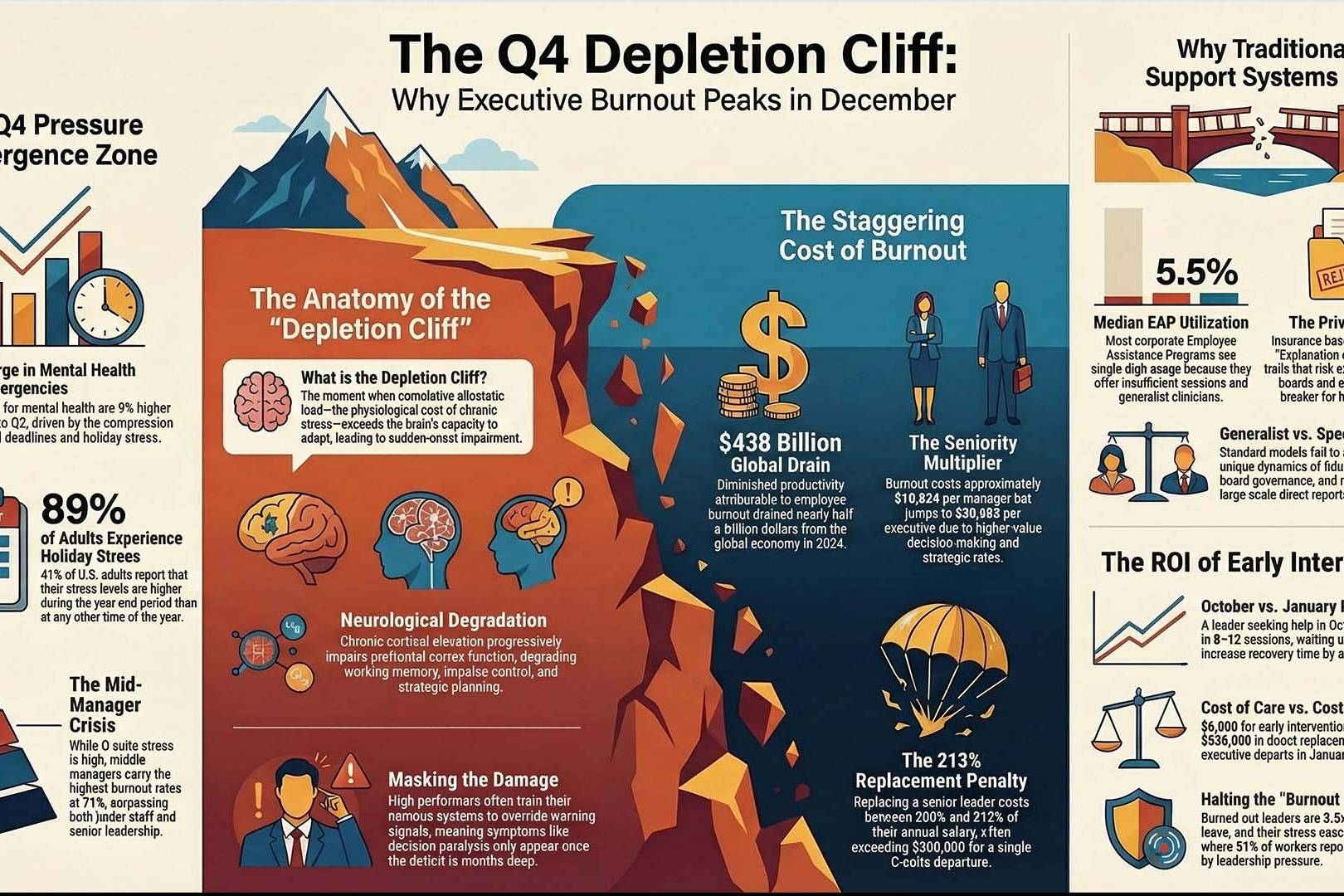
Standard mental health options systematically fail the remote leadership population. Employee Assistance Programs cap sessions at six and assign generalist clinicians who may suggest “setting boundaries with technology” to a CEO whose competitive advantage depends on digital responsiveness. Insurance-based therapy introduces privacy risks through Explanation of Benefits statements visible to employers and boards — a career-threatening exposure for a senior leader. Scheduling constraints make weekly in-person appointments impossible for executives managing teams across time zones. CEREVITY’s model was built to solve each of these failures: specialized clinicians who understand executive-level digital fatigue, total privacy through private-pay billing with no insurance paper trail, and flexible nationwide telehealth scheduling that works around demanding professional calendars — not the other way around.
A Clinical Framework for Digital Recovery
CEREVITY’s clinical experience across more than 30 states has revealed that generic stress management approaches — mindfulness apps, time-management workshops, corporate wellness days — fail to address digital fatigue because they treat the symptom rather than the system. Our clinicians have developed a four-part recovery framework specifically designed for high-achieving remote leaders whose cognitive capital is their most valuable and most threatened asset.
1. Cognitive Load Audit
Before prescribing solutions, CEREVITY clinicians conduct a thorough audit of the leader’s digital cognitive load — mapping every tool, platform, notification channel, and meeting cadence that consumes executive function. This is analogous to a financial audit: you cannot reduce costs you have not measured. Most leaders are shocked to discover they process 300+ discrete digital interactions per day, each demanding a micro-decision that depletes the same cognitive reserves needed for strategic thinking. The audit creates a baseline against which recovery can be measured.
2. Separate Identity from Digital Presence
The Presence Paradox thrives when leaders unconsciously fuse their professional identity with their digital availability. Therapy helps leaders recognize and dismantle this fusion — building a stable sense of professional worth that does not depend on response time, camera-on compliance, or Slack activity status. This is not about “unplugging” — an unrealistic prescription for most executives. It is about developing the psychological infrastructure to be selectively present rather than reflexively available, preserving cognitive capacity for the decisions that actually matter.
3. Build Cognitive Recovery Protocols
Evidence-based recovery is not meditation or vacation — it is structured cognitive restoration embedded within the workday. CEREVITY clinicians help leaders design transition rituals between meetings, implement strategic camera-off policies, and build “cognitive buffer zones” that allow the prefrontal cortex to reset between high-demand interactions. Research shows that even 90-second intentional transitions between meetings can reduce cumulative fatigue by up to 30 percent. The goal is not fewer hours — it is higher-quality cognitive hours.
4. Reframe the ROI of Recovery
High-achieving professionals respond to frameworks, not platitudes. CEREVITY clinicians help leaders quantify the cost of their current cognitive state — in missed opportunities, degraded decisions, relational damage, and health risk — against the investment in structured recovery. A weekly therapy session at CEREVITY’s rates costs less than a single day of diminished executive performance. When a burned-out CEO costs their organization $52,000 annually in lost productivity and their replacement would cost $800,000, the ROI of prevention becomes not just justifiable but strategically obvious.
Frequently Asked Questions
Questions About This Research and CEREVITY
This whitepaper synthesizes findings from peer-reviewed research, large-scale workforce surveys, and clinical observations. Primary sources include Microsoft’s 2025 Work Trend Index (100,000+ global workers), Gallup’s 2025 State of the Global Workplace Report (195,000+ respondents across 140+ countries), Deloitte’s 2025 Workforce Intelligence Report, and Stanford University’s Zoom Exhaustion and Fatigue research program. Data spans 2023–2026 and is supplemented by CEREVITY’s clinical observations across clients in more than 30 U.S. states.
Key behavioral markers include: difficulty concentrating during afternoon meetings despite adequate sleep; checking email or Slack compulsively within minutes of waking; feeling cognitively “empty” after back-to-back video calls; irritability with family members that begins specifically after the workday; inability to recall decisions made earlier the same day; a growing sense that you are performing leadership rather than actually leading; and physical symptoms including eye strain, tension headaches, and disrupted sleep architecture. If three or more of these markers persist for more than two weeks, professional support is warranted. CEREVITY clinicians specialize in this exact presentation and serve clients nationwide.
Concierge individual therapy is specialized mental health support designed for high-achieving professionals. Unlike general therapy, our therapists understand the specific pressures of executive leadership, legal practice, medical careers, and entrepreneurship. They will not minimize your stress or suggest generic solutions. CEREVITY provides this highly specialized support through secure telehealth nationwide.
As a private-pay concierge practice, we offer structured investments in your mental health without the restrictions or privacy risks of insurance. You can review our full fee schedule and specific session lengths directly on our website. While this costs more than insurance copays, it provides the flexibility, total privacy, and highly specialized care that standard options cannot offer. View our current rates here.
Privacy is foundational to our practice. As a private-pay practice, your sessions never appear on insurance records or EOBs that could be seen by employers, boards, or family members. We use HIPAA-compliant nationwide telehealth platforms, and you can attend sessions from anywhere with a private internet connection.
This Whitepaper Was Produced by CEREVITY
CEREVITY is a nationwide concierge telehealth therapy practice providing private-pay individual therapy for high-achieving professionals. Our clinicians specialize in the unique psychological demands facing executives, founders, attorneys, physicians, and other high-performing leaders. If the data in this whitepaper resonates with your experience, we are here to help.
Available by appointment 7 days a week, 8 AM to 8 PM (PST)
Methodology and Sources
This whitepaper draws on peer-reviewed research, large-scale workforce surveys, and clinical observations gathered between 2023 and 2026. Primary data sources include Microsoft’s annual Work Trend Index (100,000+ global respondents), Gallup’s State of the Global Workplace reports (195,000+ respondents across 140+ countries), Deloitte’s Workforce Intelligence reports, Stanford University’s Virtual Human Interaction Lab research on videoconference fatigue, and published findings from the American Psychological Association and World Health Organization. Financial impact estimates are derived from Gallup’s global engagement cost models and Deloitte’s workforce productivity analyses. CEREVITY’s clinical observations across clients in more than 30 U.S. states provide qualitative context for the quantitative findings. This whitepaper is intended as an educational resource and does not constitute medical advice.
References
1. Gallup. (2025). State of the Global Workplace 2025 Report. Retrieved from https://www.gallup.com/workplace/349484/state-of-the-global-workplace.aspx
2. Microsoft. (2025). 2025 Work Trend Index: The Year the Frontier Firm Was Born. Retrieved from https://www.microsoft.com/en-us/worklab/work-trend-index/
3. Perlow, L., Hadley, C., & Eun, E. (2017). Stop the Meeting Madness. Harvard Business Review. Retrieved from https://hbr.org/2017/07/stop-the-meeting-madness
4. Apollo Technical. (2025). Remote Work Burnout Statistics. Retrieved from https://www.apollotechnical.com/remote-work-burnout-statistics/
5. Gallup. (2024). The Manager’s Role in Employee Engagement. Retrieved from https://www.gallup.com/workplace/285674/improve-employee-engagement-workplace.aspx
6. Deloitte. (2025). 2025 Workforce Intelligence Report: The Burnout Equation. Retrieved from https://www2.deloitte.com/us/en/insights/topics/talent.html
7. American Psychological Association. (2024). Work in America Survey: Psychological Safety in the Changing Workplace. Retrieved from https://www.apa.org/pubs/reports/work-in-america
8. Bailenson, J.N. (2021). Nonverbal Overload: A Theoretical Argument for the Causes of Zoom Fatigue. Technology, Mind, and Behavior, 2(1). Retrieved from https://tmb.apaopen.org/pub/nonverbal-overload
9. World Health Organization. (2019). Burn-out an “occupational phenomenon”: International Classification of Diseases. Retrieved from https://www.who.int/news/item/28-05-2019-burn-out-an-occupational-phenomenon-international-classification-of-diseases
10. Fauville, G., Luo, M., Queiroz, A.C.M., Bailenson, J.N., & Hancock, J. (2021). Zoom Exhaustion & Fatigue Scale. Computers in Human Behavior Reports, 4, 100119. Retrieved from https://doi.org/10.1016/j.chbr.2021.100119
About the Author

About Martha Fernandez, LCSW
Martha Fernandez is the Co-Founder of CEREVITY and a licensed clinical social worker (LCSW) and psychotherapist serving high-achieving professionals. With specialized training in executive psychology and entrepreneurial mental health, Martha brings deep expertise in the unique challenges facing leaders, attorneys, physicians, and other accomplished professionals. Her work focuses on helping clients navigate high-stakes careers, optimize performance, and maintain psychological wellness amid demanding professional lives. Martha’s approach combines evidence-based therapeutic techniques with an understanding of the discrete, flexible care that busy professionals require. View Full Bio
⚠️ Crisis Resources
If you are experiencing a mental health crisis or having thoughts of suicide, please reach out immediately:
988 Suicide & Crisis Lifeline: Call or text 988
Crisis Text Line: Text HOME to 741741
National Alliance on Mental Illness (NAMI): 1-800-950-NAMI (6264)