Therapist Insights / Conditions We Treat
Hypervigilance: always scanning the room.
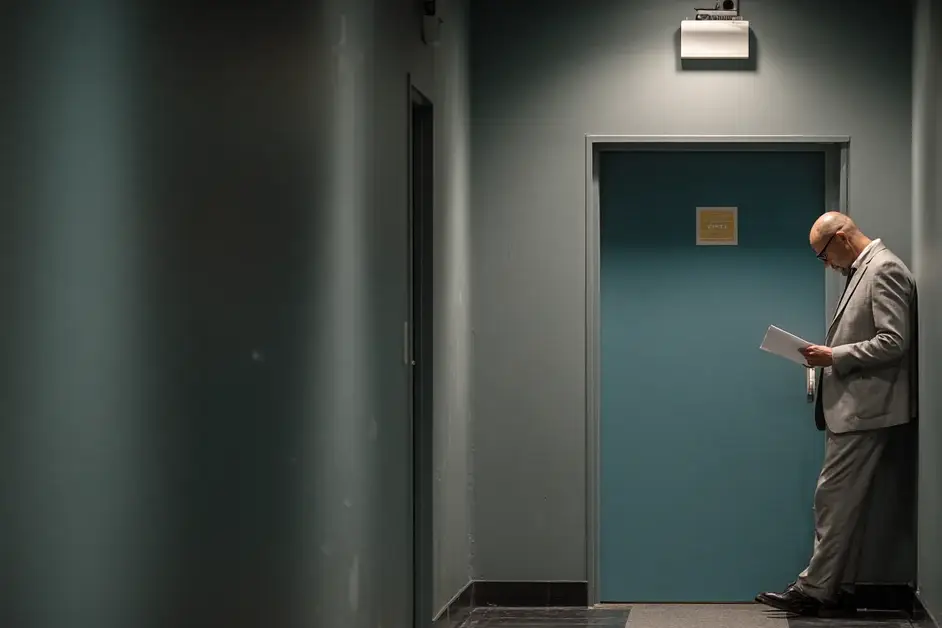
From the outside it reads as competence. Reading the room before speaking, tracking an expression through a deposition, noticing which board member stopped taking notes. The skill is real. The cost is that it no longer stops.

THE QUICK TAKEAWAY
Hypervigilance is a symptom rather than a diagnosis, and senior professionals should know DSM-5-TR lists it inside the post-traumatic stress disorder criteria under criterion E, alongside irritability, risky behaviour, heightened startle, difficulty concentrating and difficulty sleeping, with two of those six required for that criterion alone to be met. Hypervigilance also appears well outside PTSD, in anxiety presentations, chronic pain, sustained sleep deprivation and genuine ongoing threat. CEREVITY clinicians work private-pay, with no claim submitted to any insurer.
§01 / 09 / Definition
What hypervigilance is and is not.
Hypervigilance is one of six criterion E items in the DSM-5-TR post-traumatic stress disorder criteria, and two of those six are required for that criterion alone to be met. Senior professionals should note that no separate diagnosis or code exists for it and no standalone validated instrument measures it.
Hypervigilance is a symptom, not a diagnosis. DSM-5-TR lists it inside the post-traumatic stress disorder criteria, under criterion E, alterations in arousal and reactivity, alongside irritability or aggression, risky or destructive behavior, heightened startle reaction, difficulty concentrating, and difficulty sleeping. Two of those six items are required for that criterion to be met, and criterion E is only one of several criteria the diagnosis requires. Nothing permits diagnosing hypervigilance on its own, and no separate code exists for it. The symptom also appears well outside PTSD: in anxiety presentations, in chronic pain, in sustained sleep deprivation, and in people working under genuine and continuing threat of consequence. For a senior professional, hypervigilance usually reads from the outside as competence. Reading the room before speaking. Tracking a general counsel's expression through a deposition. Noticing which board member stopped taking notes. The skill is real and the cost is that it no longer switches off when the setting changes. CEREVITY is a nationwide network of independent licensed clinicians working with professionals whose scanning has stopped being selective. Care is private-pay, so no insurance claim is submitted and nothing is routed through an employer.
Six pressures that keep the scanning switched on
Scanning that started as a professional skill
Reading a room is trained behavior in litigation, deal work, medicine, and command. Noticing who disengaged, whose posture changed, which number the auditor lingered on. The capability is genuine and rewarded. The difficulty arrives when it stops being selective and runs at the same intensity in a restaurant, at a child's recital, and at three in the morning.
Sleep that never fully closes
Difficulty sleeping sits in the same DSM-5-TR criterion as hypervigilance and usually travels with it. People describe sleeping lightly, waking at any sound, checking the house, or lying still while the mind runs the next day's contingencies. Sleep debt then lowers the arousal threshold further, which makes the scanning worse the following day.
Startle in front of people who matter
Heightened startle response is embarrassing in senior settings. A dropped tray, a door closing hard, a hand on the shoulder from behind, and the reaction is visible to a board or a team. Most people then add a second layer of monitoring aimed at concealing the first, which increases total load rather than reducing it.
Irritability that reaches the people closest first
Irritability or aggression is the first criterion E item, and it rarely surfaces at work, where control is strongest. It arrives at home, at the end of the day, aimed at minor things. Partners and children experience the sharpest version of a state that colleagues never see, and the discrepancy is itself a source of shame.
Concentration that fails on the deep work
Difficulty concentrating is another criterion E item and is often the one that finally prompts a call. Meetings and email survive because they are externally paced. The long brief, the manuscript, the model, the strategy document: those require sustained internal attention, and a nervous system running background threat detection cannot supply it.
Attributing all of it to workload
Almost everyone at this level explains the pattern by pointing at the calendar. The explanation is plausible, partially true, and it predicts that a vacation will fix things. When two weeks away change nothing, most people conclude they need a longer break rather than that the scanning has become independent of the workload that started it.
▶ Research
Assessment in this area is more constrained than most consumer material implies. The United States National Center for PTSD reproduces the DSM-5-TR criteria and lists hypervigilance as one of six criterion E items, with the marker two required attached to that criterion. Measurement therefore happens inside post-traumatic stress disorder instruments rather than separately from them: the PTSD Checklist is described by the same body as a 20-item self-report measure covering all 20 symptoms, with cluster E occupying items 15 to 20. That page also states that the gold standard for diagnosing post-traumatic stress disorder is a structured clinical interview such as the Clinician-Administered PTSD Scale, and that interpretation of the checklist should be made by a clinician rather than by the person completing it. A score from an online quiz is not a diagnosis.1
What the evidence supports, and what it does not measure
Two of six, and criterion E is one criterion of several
Hypervigilance sits among six criterion E items in the DSM-5-TR post-traumatic stress disorder criteria, alongside irritability or aggression, risky or destructive behaviour, heightened startle, difficulty concentrating and difficulty sleeping. Two are required for that criterion, and criterion E is only one of several the diagnosis requires. Hypervigilance alone does not satisfy even one criterion.
The prevalence data attaches to PTSD, not to the symptom
NIMH reports an estimated 3.6% of United States adults with past-year post-traumatic stress disorder, 5.2% of females and 1.8% of males, and 6.8% lifetime, from fieldwork conducted between February 2001 and April 2003 under DSM-IV criteria with the disorder assessed in a subsample of 5,692 adults. Nothing in that dataset reports how many adults experience hypervigilance without meeting full criteria.
Guidance targets the disorder, and one guideline is not American
NICE guideline NG116 tells clinicians in England to offer EMDR to adults presenting more than three months after a non-combat-related trauma, typically over eight to twelve sessions. NICE governs the English health service and is not a United States regulatory standard. The wider picture is sobering: the international guideline body issued 125 recommendations in 2018 of which 78 were classed as insufficient evidence to recommend.
Who carries this with you
A household living alongside constant scanning adapts around it quietly, and the adaptation is usually invisible to the person doing the scanning.
The partner sharing the house
Spouses notice the specifics first: the seat facing the door, the second check of the locks, the waking at every noise, the flat reaction to good news. Many stop commenting because commenting produces defensiveness. Naming the pattern as a recognized arousal symptom rather than a personality trait usually reopens that conversation.
Children reading the room back
Children calibrate to a parent's alertness with unnerving accuracy and often become monitors themselves. Parents rarely see it until a teacher or a pediatrician mentions it. This is commonly the point at which a senior professional who had accepted their own symptoms decides the pattern is worth treating.
The team on the receiving end
Staff experience hypervigilance as scrutiny. Faster follow-ups, more questions, a sense of being checked. Performance may hold or even improve in the short run while trust erodes underneath, and the leader is usually the last person in the building to learn that the atmosphere has changed.
§02 / 09 / Telehealth
Why it reads as competence.
Situational awareness is genuinely valuable in senior roles, which is why the symptom is rewarded long before it is noticed. Senior professionals typically describe the skill as an asset for years and only bring it to a clinician when it stops switching off in settings that do not require it.
Accurate naming of what is happening
Learning that hypervigilance is a defined symptom inside PTSD criterion E, not a character defect and not a standalone illness, changes what a person does next. The question stops being what is wrong with me and becomes whether the full criteria are met, which is answerable by assessment rather than by rumination.
Selectivity returns
The goal is not to switch off threat detection, which would be neither achievable nor desirable in a courtroom or an operating room. The goal is recovering the ability to run it deliberately and then stand it down. Clients usually notice the change first in restaurants, on flights, and in the last hour before sleep.
Assessment that stays private
CEREVITY is a nationwide network of independent licensed clinicians and the work is private-pay. No insurance claim is submitted and nothing routes through an employer or a credentialing body. For people whose roles involve licensure, security clearance, or fiduciary duty, that structure determines whether assessment happens at all.
§03 / 09 / Mechanism
What the treatment guidelines actually target.
Guidelines address post-traumatic stress disorder rather than hypervigilance in isolation, and no guideline located supports a treatment aimed at the symptom alone. Senior professionals should read that as a reason for assessment rather than as a reason to self-manage.
No standalone diagnosis of hypervigilance exists in DSM-5-TR, and no validated instrument measuring it in isolation was located during this research. The U.S. National Center for PTSD reproduces the criteria and lists hypervigilance as one of six criterion E items, with the marker '2 required' attached to that criterion. Assessment therefore happens inside PTSD measurement rather than separately from it. The PTSD Checklist, known as the PCL-5 and named for the manual edition in which those criteria were introduced, is described by the same body as a 20-item self-report measure covering all 20 PTSD symptoms, with cluster E occupying items 15 to 20. That page also states that the gold standard for diagnosing PTSD is a structured clinical interview such as the Clinician-Administered PTSD Scale, and that interpretation of the checklist should be made by a clinician rather than by the person completing it.
Prevalence figures in this area attach to PTSD, not to hypervigilance. NIMH reports, drawing on the National Comorbidity Survey Replication, that an estimated 3.6% of U.S. adults had PTSD in the past year, 5.2% of females and 1.8% of males, and that lifetime prevalence was 6.8%. That survey ran face to face between February 2001 and April 2003, applied DSM-IV criteria, interviewed 9,282 English-speaking non-institutionalized civilian respondents, and assessed PTSD in a subsample of 5,692 adults. Nothing in that dataset reports how many adults experience hypervigilance without meeting full PTSD criteria, and no national estimate exists for executives, physicians, or attorneys specifically. Any percentage of that kind circulating online should be treated as unsourced until a study is produced.
Treatment guidelines for PTSD target the disorder rather than the hypervigilance symptom, which is the practical consequence of everything above. NICE guideline NG116 tells clinicians in England to offer EMDR to adults with a diagnosis of PTSD or clinically important symptoms of PTSD who present more than three months after a non-combat-related trauma, and to consider it between one and three months where the person prefers it, typically over eight to twelve sessions and more after multiple traumas. NICE guidance governs the English health service and is not a United States regulatory standard. The wider guideline picture is sobering: the International Society for Traumatic Stress Studies issued 125 recommendations in 2018 of which 78 were classed as insufficient evidence to recommend. No guideline located supports a treatment aimed at hypervigilance alone.
► Standard advice vs. CEREVITY's approach
Standard therapy
"I am just wired this way and always have been."
CEREVITY
"The scanning got worse after a specific period, which means it has a start date and a pattern."
Standard therapy
"I need to relax more on the weekends."
CEREVITY
"Two weeks off did not change it, so the problem is not recovery time."
Standard therapy
"Everyone in my job is on edge like this."
CEREVITY
"Being alert at work is normal. Being unable to stand it down at home is the part to assess."
| Standard insurance-based therapy | CEREVITY's specialized approach |
|---|---|
| "I am just wired this way and always have been." | "The scanning got worse after a specific period, which means it has a start date and a pattern." |
| "I need to relax more on the weekends." | "Two weeks off did not change it, so the problem is not recovery time." |
| "Everyone in my job is on edge like this." | "Being alert at work is normal. Being unable to stand it down at home is the part to assess." |
A break from the page
Find out what the scanning belongs to.
A first conversation is confidential and commits you to nothing. CEREVITY is a nationwide network of independent licensed clinicians working private-pay, with no claim submitted to any insurer and nothing routed through your employer. You can send a private inquiry in about two minutes.
§04 / 09 / Cases
Common challenges we address.
The symptom is also a professional asset
The patternClients resist treating hypervigilance because it has been rewarded. A trial attorney who reads a jury, a surgeon who notices the anesthesiologist's expression, an operator who catches a discrepancy in a data room. Removing the vigilance sounds like removing the edge that built the career, and no argument about wellbeing outweighs that fear.
What we addressTreatment does not aim to abolish threat detection. The target is voluntary control: running it hard in the courtroom, standing it down at dinner. Clinicians frame the work that way from the first session, because a client who believes they are being asked to become less observant will disengage before the assessment is finished.
Assessment feels like exposure to a record
The patternNaming trauma symptoms out loud raises immediate practical concerns for licensed and fiduciary professionals: licensure questions, security clearance renewals, disability underwriting, partnership disclosure. The concern is legitimate rather than avoidant, and unaddressed it converts into indefinite postponement dressed up as being too busy this quarter.
What we addressStructure answers the concern before content does. Care through the CEREVITY network is private-pay, so no insurance claim is submitted, nothing routes through an employer, and no group plan or benefits administrator receives a diagnosis. Clinicians set out what is documented, what is not, and what the limits of confidentiality actually are, at the outset.
§05 / 09 / Methods
Evidence-based treatment approaches.
CEREVITY clinicians work with senior professionals on the prior question rather than on the symptom in isolation: whether the hypervigilance belongs to post-traumatic stress disorder, to an anxiety presentation, to chronic pain, to sustained sleep deprivation, or to a work situation carrying genuine ongoing threat. Each answer changes the treatment entirely.
Structured diagnostic assessment
Assessment establishes whether the full PTSD criteria are met, using clinical interview supported by a self-report measure such as the PCL-5, where criterion E occupies items 15 to 20. The National Center for PTSD states that the gold standard is a structured clinical interview and that checklist interpretation belongs to a clinician. Formulation drives the treatment choice rather than the symptom label.
Trauma-focused cognitive behavioral therapy
Where PTSD criteria are met, trauma-focused CBT carries the strongest randomized evidence of any intervention in this area. Work targets the trauma memory and the appraisals attached to it, and arousal symptoms including hypervigilance typically fall as a consequence rather than as a direct target. Delivered in the 50-minute format across a defined course.
EMDR
NICE guideline NG116 tells clinicians in England to offer EMDR to adults with a PTSD diagnosis or clinically important symptoms presenting more than three months after non-combat-related trauma, typically over eight to twelve sessions and more where multiple traumas occurred. That guidance is English rather than American, and CEREVITY clinicians say so when they describe it to a client.
A 90-minute session for stabilization and in-session practice
Arousal work benefits from room to activate and settle inside the same appointment. A 90-minute session allows a full assessment of the scanning pattern, a paced breathing or grounding trial run to completion, and a plan for the specific settings that trigger it, without the clinician ending the hour with a client still elevated and due back in the office.
Sleep-focused cognitive behavioral therapy
Difficulty sleeping and hypervigilance reinforce each other, and treating the sleep component often produces the first measurable change. CBT for insomnia has its own randomized evidence base independent of the trauma literature, uses stimulus control and sleep restriction rather than sedation, and gives a client an early result while the longer trauma work proceeds.
§06 / 09 / Investment
Understanding the investment in private-pay care.
Private-pay, nationwide, and outside anything adversarial
At CEREVITY, our online individual therapy sessions are structured as a direct investment in your mental agility and overall well-being. The investment includes:
- Licensed mental health professional specializing in therapy for hyperarousal and hypervigilance
- Evidence-based, one-on-one approaches proven effective for constant scanning, startle, and difficulty switching off
- Flexible online scheduling including evenings and weekends
- Complete privacy with no insurance involvement or red tape
- Senior professionals expertise and understanding
- Outcome tracking and progress measurement
The cost of hypervigilance going unaddressed
Consider what is at stake when hypervigilance goes unaddressed:
Cognitive capacity spent on background processing
Continuous threat detection consumes attention that would otherwise go to judgment. The visible effects are late: decisions deferred, drafts unfinished, meetings that require a second meeting. Most professionals compensate by extending hours, which increases sleep debt, which lowers the arousal threshold further and deepens the pattern they were compensating for.
Relationships recalibrate around the alertness
Households adapt quietly. Family members lower their voices, avoid surprises, prepare the person for arrivals, and stop raising difficult topics late in the day. Each adjustment is small and reasonable, and together they produce a home organized around one person's nervous system, which is a cost paid mostly by everyone else.
§07 / 09 / Evidence
What the research shows.
Three findings frame this properly. Hypervigilance is one of six criterion E items in the DSM-5-TR post-traumatic stress disorder criteria, two of which are required for that criterion alone, and no separate diagnosis or code exists for it. Prevalence data in this area attaches to the disorder rather than the symptom, at an estimated 3.6% of United States adults in the past year and 6.8% lifetime, from fieldwork conducted between February 2001 and April 2003 under DSM-IV criteria. And no guideline located supports a treatment aimed at hypervigilance alone.
► Three numbers about the disorder, not the symptom
criterion E items required for that criterion alone to be met; hypervigilance is one of the six
DSM-5-TR criteria, National Center for PTSD
of US adults with past-year post-traumatic stress disorder, fieldwork 2001 to 2003, DSM-IV criteria, subsample of 5,692
NIMH, NCS-R
international guideline recommendations classed as insufficient evidence to recommend
J Trauma Stress, 2019
Read together, those argue for assessment rather than for a technique aimed at the scanning itself. The differential is genuinely wide. Hypervigilance appears in post-traumatic stress disorder, in generalised and social anxiety, in chronic pain, in sustained sleep deprivation, and in people working under real and continuing threat of consequence, where the scanning is an accurate reading of the environment rather than a symptom. That last category matters for senior professionals more than for most populations, and treating an accurate perception as pathology is its own kind of error. What treatment addresses, once the picture is clear, is selectivity: whether the scanning still switches off when the setting changes, and what happens in the hours after it does not. Most of that runs through private individual sessions across the standard weekly length, with priority access to a clinician available separately for people whose weeks do not hold a fixed slot.
§§ / 09 / Recap
Key takeaways.
Five things to remember
- A symptom, not a diagnosis Hypervigilance sits inside the DSM-5-TR post-traumatic stress disorder criteria as one of six criterion E items. No separate code exists and no standalone validated instrument measures it.
- A checklist score is not a diagnosis The National Center for PTSD states that the gold standard is a structured clinical interview and that checklist interpretation belongs to a clinician rather than to the person completing it.
- The differential is wide Anxiety presentations, chronic pain, sustained sleep deprivation and genuine ongoing threat all produce it. Treating an accurate reading of a hostile environment as pathology is its own error.
- Guidance targets the disorder No guideline located supports treatment aimed at hypervigilance alone, and NICE guidance governs the English health service rather than United States practice.
- CEREVITY provides this through online individual therapy nationwide, with full privacy through its private-pay concierge network and no insurance involvement.
§08 / 09 / FAQ
Frequently asked questions.
What is hypervigilance?
Hypervigilance is a state of heightened, continuous scanning for threat, and senior professionals should know it is a symptom rather than a diagnosis. DSM-5-TR lists it under criterion E of the post-traumatic stress disorder criteria, alterations in arousal and reactivity, alongside irritability or aggression, risky or destructive behaviour, heightened startle reaction, difficulty concentrating and difficulty sleeping. Two of those six items are required for that criterion to be met, and criterion E is only one of several criteria the diagnosis requires. Nothing permits diagnosing hypervigilance on its own and no separate code exists for it. It also appears well outside post-traumatic stress disorder.
Is hypervigilance always a sign of trauma?
No, and assuming so leads people to the wrong treatment. Hypervigilance appears in generalised and social anxiety presentations, in chronic pain, in sustained sleep deprivation, in some medical and substance-related states, and in people working under real and continuing threat of consequence. That last category is not rare among senior professionals, and it is the one where the scanning is an accurate reading of the environment rather than a symptom of anything. A clinician's first job is to establish which of those applies, because treating an accurate perception as pathology is its own kind of error and tends to leave the person distrusting both the therapy and their own judgment.
How do I know if my situational awareness has become a problem?
Selectivity is the practical test. Professional situational awareness switches on where it is useful and switches off elsewhere. Senior professionals usually describe the shift as a loss of that boundary: the scanning continues at dinner, during a film, on holiday, or at three in the morning, and the arousal costs sleep. Two further markers are worth attending to, and both come from the criteria rather than from intuition: heightened startle, and difficulty concentrating that is not explained by workload. None of this is self-diagnosable. The National Center for PTSD states that the gold standard for diagnosis is a structured clinical interview and that checklist interpretation belongs to a clinician.
How is hypervigilance treated?
Treatment targets whatever the symptom belongs to rather than the symptom in isolation, and no guideline located supports an intervention aimed at hypervigilance alone. Where post-traumatic stress disorder is present, established trauma-focused treatments apply. NICE guideline NG116 tells clinicians in England to offer EMDR to adults presenting more than three months after a non-combat-related trauma, typically over eight to twelve sessions and more after multiple traumas, though NICE governs the English health service rather than United States practice. The broader guideline picture is worth knowing: the international guideline body issued 125 recommendations in 2018 of which 78 were classed as insufficient evidence to recommend.
Can hypervigilance affect my work?
Usually it improves the work first and taxes everything else. Senior professionals frequently arrive having been rewarded for years for exactly this capacity, and the cost shows up in sleep, in irritability at home, and in an inability to be off duty rather than in performance. That sequencing is why the pattern reaches a clinician late. CEREVITY is a nationwide network of independent licensed clinicians working private-pay, with no claim submitted to any insurer and nothing routed through an employer, in 50-minute sessions or a 90-minute session where a full history needs taking at once.
How does your private-pay pricing structure work?
As a private-pay concierge network, we offer structured investments in your mental health without the restrictions or privacy risks of insurance. You can review our full fee schedule and specific session lengths directly on our website. While this costs more than insurance copays, it provides the flexibility, total privacy, and highly specialized care that standard options cannot offer. View our current rates here.
How do you protect my privacy?
Privacy is foundational to our network. As a private-pay network, your sessions never appear on insurance records or EOBs that could be seen by employers, boards, or family members. We use HIPAA-compliant nationwide telehealth platforms, and you can attend sessions from anywhere with a private internet connection.
§09 / 09 / Begin
Establish what it belongs to.
Hypervigilance appears in several conditions and in some environments where it is simply accurate, and those possibilities lead to entirely different work. Sessions are private-pay, with no claim submitted to any insurer and nothing routed through an employer. Senior professionals can send a private inquiry in about two minutes, or call and speak to somebody directly.
Seven days a week, early morning to late evening · Current hours on the contact page, in your time zone§§ / Author
About Lucia Hernandez, PhD.
Lucia Hernandez, PhD
Dr. Hernandez is a Licensed Psychologist providing therapy for executives, entrepreneurs, and high-achieving professionals. Her work integrates evidence-based cognitive and psychodynamic approaches with a culturally responsive lens, calibrated to the realities of high-responsibility careers. She sees clients via CEREVITY's nationwide telehealth network. View full bio →
§§ / Sources
References.
- U.S. Department of Veterans Affairs, National Center for PTSD. PTSD Basics: Diagnostic Criteria for PTSD. 2024. ptsd.va.gov
- National Institute of Mental Health. Post-Traumatic Stress Disorder (PTSD). 2026. nimh.nih.gov
- U.S. Department of Veterans Affairs, National Center for PTSD. PTSD Checklist (PCL-5). 2024. ptsd.va.gov
- National Institute for Health and Care Excellence, guideline NG116. Post-traumatic stress disorder: Recommendations. 2018. nice.org.uk
- Journal of Traumatic Stress. The ISTSS New Guidelines for the Prevention and Treatment of Posttraumatic Stress Disorder: Methodology and Development Process. 2019. europepmc.org
- CEREVITY. Leadership isolation therapy. cerevity.com/leadership-isolation-therapy
- CEREVITY. Imposter syndrome therapy. cerevity.com/imposter-syndrome-therapy
- CEREVITY. High-functioning anxiety and depression therapy. cerevity.com/anxiety-and-depression-therapy
⚠ Crisis resources
If you are experiencing a mental health crisis or having thoughts of suicide, please reach out immediately. 988 Suicide & Crisis Lifeline · Call or text 988 Crisis Text Line · Text HOME to 741741 National Alliance on Mental Illness · 1-800-950-NAMI (6264)