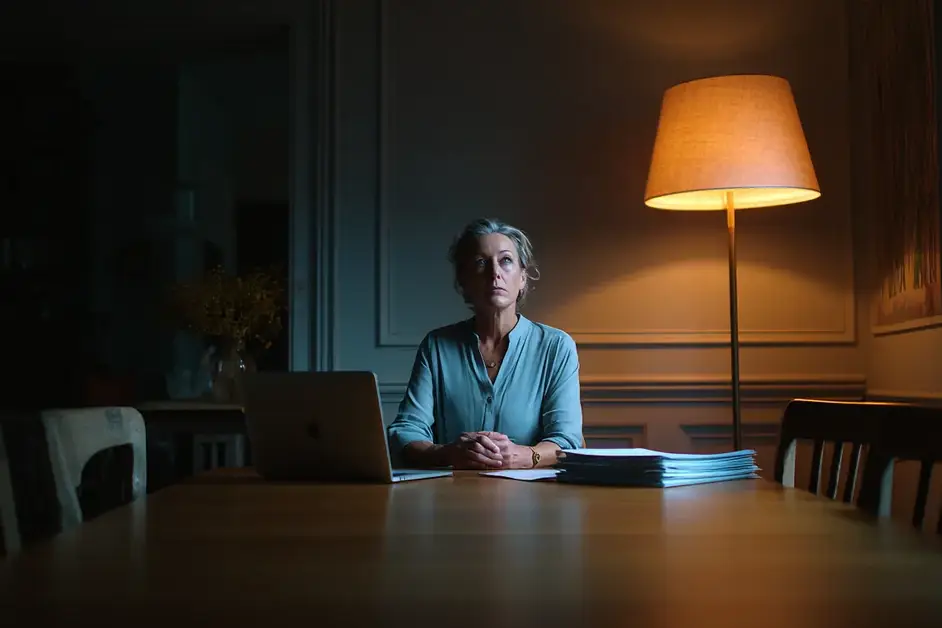
Therapist Insights / Emergency Medicine Wellbeing
Therapy for emergency physicians on the front line.
Emergency medicine is one of the few specialties in which the body never gets to settle into a rhythm. Nights rotate, criticals arrive without spacing, and the department fills with admitted patients who have nowhere to go. This is therapy built for that constraint: private-pay, by secure telehealth nationwide across all 50 states, with no claim filed and nothing routed through a hospital.

THE QUICK TAKEAWAY
Emergency physicians absorb two things that no other medical specialty concentrates in quite the same way: permanent circadian disruption from rotating night work, and repeated critical incidents with no processing gap between them. CEREVITY connects emergency physicians and residents with independent licensed clinicians on a private-pay basis, with no insurance claim, no diagnosis on a payer record, and nothing routed through a hospital, a group or a residency program. The presenting picture is usually some combination of occupational burnout, sleep that has stopped repairing itself, and distress about care the department could not deliver.
§01 / 09 / Definition
What rotating nights actually do.
Night rotation misaligns the circadian system against the working schedule, and emergency physicians live inside that misalignment for a career. StatPearls records that among 2,570 US shift workers, 14% of night workers and 8% of rotating shift workers met the criteria for shift work disorder.
Almost every specialty in medicine asks for long hours. Emergency medicine is one of a very small number that asks for them at three in the morning, then at nine the following evening, then at seven the morning after that, for thirty years. The distinction matters more than it sounds. StatPearls, in its review of shift work hazards last updated in February 2024, describes the mechanism plainly: shift work is often in opposition to the regular circadian rhythm of workers, requiring them to maintain a sleep/wake cycle that is misaligned with natural physiology. That is not a description of being tired. It is a description of a physiological system being asked to run against its own clock, indefinitely, and the review lists the associated outcomes without much hedging: impaired cognition and decreased job performance across professions including nurses and medical residents, and an association between shift work and cardiovascular disease, metabolic syndrome, obesity, type II diabetes, gastrointestinal disturbance and several cancers. The finding that matters most in a psychological context is narrower and sharper. Depression, the review states, is more strongly associated with rotating shift work than with fixed shifts. Emergency medicine is rotating shift work almost by definition. CEREVITY works across medicine through its therapy for physicians, and the emergency version of the problem has a distinctive shape: the exhaustion is not only cumulative, it is chronobiological, and it does not resolve on a stretch of days off because the clock resets from scratch the moment the next night block begins.
Five pressures specific to emergency medicine
A clock that never settles
Fixed nights are hard on a body and rotating nights are harder, because the circadian system never finishes adapting to one pattern before it is asked to adapt to another. StatPearls records that 14 percent of night workers and 8 percent of rotating shift workers in a study of 2,570 US shift workers met the criteria for shift work disorder, a diagnosis that requires symptoms for at least three months.
Exposure without spacing
Other specialties encounter catastrophe occasionally and then have hours or days in which to absorb it. An emergency physician can run a failed resuscitation and be taking a history in the next room eleven minutes later. The exposure is not unusually severe compared with the rest of medicine. What is unusual is the density, and the complete absence of a processing interval.
Boarding and the corridor
The American College of Emergency Physicians defines boarding as holding patients in the emergency department after they have been admitted to the hospital, because no inpatient beds are available, and states that over 90 percent of emergency departments routinely report crowded conditions. The clinical work becomes the management of a queue that the physician did not create and cannot clear.
Outcomes that never close
Continuity is structurally absent. Patients are stabilised, admitted, transferred or discharged, and most of the time nobody tells you what happened next. A career accumulates a large number of unfinished stories, and the mind tends to fill the gaps with the worst available ending rather than the most likely one.
Being the last stop
Nothing about the department is optional and nothing can be deferred to a clinic slot next month. An emergency physician is the endpoint of every other system's failure, at whatever hour the failure occurs, and that position carries a form of responsibility that does not distribute across a team or a timeline.
▶ Research
Shift work disorder is a named diagnosis with published criteria rather than a description of being tired. The StatPearls review of shift work hazards sets out the International Classification of Sleep Disorders criteria: insomnia or excessive sleepiness with reduced total sleep time, symptoms present for at least three months, sleep disturbance documented across at least fourteen days, associated functional impairment, and exclusion of other disorders. In a study of 2,570 US shift workers aged eighteen to sixty-five, 14 percent of night workers and 8 percent of rotating shift workers reported symptoms meeting those criteria. The same review records that impaired cognition and decreased job performance are common complications of shift work across several professions, including nurses and medical residents, and that depression is more strongly associated with rotating shift work than with fixed shifts. For an emergency physician, that last sentence is the one worth reading twice, because rotating is what emergency medicine mostly is.1
What the record actually shows
The exposure is repeated, which changes the target
A single catastrophic case and twenty years of moderately bad ones produce different presentations, and they respond to different work. Where one specific case intrudes without warning, the material is trauma and it is treated as trauma. Where the picture is a flattening across hundreds of cases, none of which would qualify as the worst thing that ever happened, the target is different and reassurance about any individual case is beside the point.
Sleep debt and low mood are not the same problem
Chronic circadian misalignment produces low energy, irritability, poor concentration and blunted enjoyment. So does depression. In an emergency physician working rotating nights the two overlap so completely that they are frequently treated as one thing, usually the wrong one. Separating them is not a formality, because a sleep problem treated as a mood problem gets months of therapy that does not touch it.
Competence is an excellent hiding place
An emergency physician whose department metrics are strong, whose consultants like them and whose board keeps clearing has no external signal that anything is wrong. The internal signal is a persistent sense of being one bad shift away from exposure, which is why therapy for feeling unqualified in a job you earned comes up so often with people whose objective record is excellent. High performance delays the call rather than removing the reason for it.
Who else the rotation reaches
A rotating schedule is not a private arrangement between an emergency physician and a hospital. It reorganises a household, sets the tone of a department, and changes what happens in a resuscitation room, and the people who notice the change first are almost never the physician.
The household on a different clock
Partners and children live on a fixed calendar while the physician lives on a rotating one, and the overlap keeps shrinking. Sleep during daylight has to be defended rather than simply taken. Birthdays and school events fall inside night blocks. The recognisable pattern is a person who is physically present and biologically somewhere else, whose irritability is genuinely chemical as often as it is emotional.
The department around you
Nurses, techs, residents and consulting services all calibrate to the attending's state, and a depleted attending changes the temperature of a department long before anyone names what has changed. Trainees absorb the model rather than the teaching, which is how a specialty transmits its coping style from one generation to the next without ever discussing it.
The patients still waiting
Depersonalisation is one of the measured dimensions of occupational burnout, and in an emergency department it initially presents as speed. The physician who has stopped registering the person in front of them is often the physician moving through the board fastest. Naming that early is a clinical act rather than an indulgence.
§02 / 09 / Telehealth
Exposure with no gap between.
Emergency departments concentrate critical incidents with no processing interval, and crowding adds a second layer that is administrative rather than clinical. A 2018 PLOS ONE systematic review of 102 studies found access block was the major contributor to crowding, and that crowding increased stress among emergency physicians and nurses.
Boarding is the documented driver, not a complaint
The PLOS ONE systematic review of emergency department crowding screened 4,131 studies and included 102 of them. Its finding on cause was unambiguous: every study reporting on output factors concluded that access block, defined as the inability to transfer a patient out of the emergency department to an inpatient bed once their emergency treatment has been completed, was the major contributor to crowding. The bottleneck sits downstream of the emergency physician and is invisible from the waiting room.
Crowded is the normal condition, not the exception
The American College of Emergency Physicians states that over 90 percent of emergency departments routinely report crowded conditions, that boarding delays can last hours, days, weeks or longer, and that staffing challenges and burnout exacerbate the crisis and perpetuate a dangerous and sometimes deadly cycle. An emergency physician describing the department as unmanageable is describing a documented national condition, not a personal threshold.
The cost lands on the clinician as well as the patient
The same PLOS ONE review recorded consequences on both sides of the encounter. For patients: delays in assessment and treatment, medication errors, increased inpatient mortality and reduced satisfaction. For staff: increased stress among nurses and physicians, increased exposure to violence, and non-adherence to best practice guidelines. That last item is the one that converts a system problem into a psychological one, because it is a formal way of saying that clinicians are repeatedly prevented from delivering the care they know is indicated.
§03 / 09 / Mechanism
Why the call gets delayed.
Emergency physicians delay treatment for reasons that are institutional rather than clinical. The American College of Emergency Physicians reports that 45 percent of the nation's emergency physicians do not feel comfortable seeking mental health treatment, and that 57 percent would be concerned for their job if they were to seek it.
Those two figures come from a poll ACEP conducted with Morning Consult and released in October 2020, and they are the most useful numbers in this entire subject, because they measure the obstacle rather than the illness. ACEP also reports that upwards of 65 percent of emergency physicians and emergency medicine residents report experiencing burnout during their careers, and that as of 2019 approximately 15 to 17 percent of emergency physicians, and upwards of 20 percent of emergency medicine residents, met the diagnostic criteria for post-traumatic stress disorder. Set those alongside each other and the shape of the problem is clear. The prevalence is high, the willingness to be treated is low, and the reason given is not doubt about whether therapy works. The reason given is the job.
What follows from that is a set of practical questions about where care sits rather than about what care contains. Employee assistance arrangements sit inside the employer that also schedules you, credentials you and reviews your charts. Health system wellness programs, whatever their intentions, are administered by the same organisation. Insurance-based care creates a claim, and a claim creates a diagnostic code in a payer file that will outlive the episode of care. CEREVITY is a nationwide network of independent licensed clinicians working entirely private-pay, so there is no claim, no payer diagnosis, no employer involvement, and no reporting line into the group or the hospital. Confidentiality still has the same narrow limits it has everywhere a licensed clinician works: mandated reporting where a child or dependent adult is at risk, a serious and imminent threat to an identifiable person, and lawful court process. Ordinary exhaustion, grief after a death in the department, intrusive recall of a case and burnout fall nowhere near any of those.
The licensure question is separate, and it deserves a straight answer rather than reassurance. Whether a state board or a credentialing body asks about mental health history, and what you are obliged to disclose to them, varies by jurisdiction and by institution, and the wording changes over time. That question belongs to your own board and to your own counsel, not to an article and not to a clinician. What can be said factually is that private-pay care with an independent clinician generates no insurance claim and no payer record, which is a different question from what an application asks, and conflating the two has kept a large number of emergency physicians from doing anything at all. Where a single case is what will not stop replaying, rather than the accumulation, that has its own name in the patient safety literature, the second victim response, and it is treated as trauma rather than as depletion.
► Standard advice vs. CEREVITY's approach
Standard therapy
"Treat chronic sleep disruption as something a stretch of days off will repair"
CEREVITY
"Address the sleep directly, on the assumption that the schedule stays as it is"
Standard therapy
"Route care through the hospital that also credentials and schedules you"
CEREVITY
"Work privately, paid directly, with no reporting line into the department"
Standard therapy
"Wait for a quiet month in the calendar before starting anything"
CEREVITY
"Set a cadence and a session length that survive a rotating schedule"
| Standard insurance-based therapy | CEREVITY's specialized approach |
|---|---|
| "Treat chronic sleep disruption as something a stretch of days off will repair" | "Address the sleep directly, on the assumption that the schedule stays as it is" |
| "Route care through the hospital that also credentials and schedules you" | "Work privately, paid directly, with no reporting line into the department" |
| "Wait for a quiet month in the calendar before starting anything" | "Set a cadence and a session length that survive a rotating schedule" |
A break from the page
The rotation is not going to apologise.
A first contact is confidential and commits you to nothing. CEREVITY is a nationwide network of independent licensed clinicians working private-pay, with no insurance claim submitted and no diagnosis on a payer record. If the pattern in this article is recognisable, start with a private inquiry.
§04 / 09 / Cases
Common challenges we address.
The attending whose body no longer knows what time it is
The patternSleep that never consolidates in either direction. Two hours before an alarm on a day shift, four broken hours after a night block, caffeine holding the front end of the shift together and something else holding the back end. Mood has flattened, irritability arrives at home rather than at work, and the private assessment is that this is simply what a career in emergency medicine costs. Occupational burnout and shift work disorder overlap heavily here, and so does depression.
What we addressThe work begins by separating circadian disruption from mood, because in an emergency physician the two present almost identically and respond to different things. Sleep is treated as its own clinical target rather than as a symptom that will resolve once the schedule improves, because the schedule is not going to improve. Where the picture has become chronic depletion rather than a bad quarter, the treatment path runs through clinical work on burnout that has stopped responding to time off.
The physician who has stopped minding any of it
The patternA stretch of years in which the deaths stopped registering, the difficult families became a category rather than people, and the resuscitation that would once have taken a week to shake now takes about as long as the drive home. Colleagues read it as composure. Metrics read it as efficiency. From the inside it is closer to an absence, and it is frequently accompanied by a quiet certainty that something has been permanently lost.
What we addressDepersonalisation is a measured dimension of occupational burnout rather than a personality change, and it is the one emergency physicians recognise last precisely because a department rewards it. Treatment targets the blunting itself rather than trying to talk anyone back into feeling things about individual cases. Where one specific case is still intruding on its own, that is the second victim presentation, it has its own literature, and it is worked with as trauma rather than as exhaustion.
§05 / 09 / Methods
Evidence-based treatment approaches.
Treatment for emergency physicians is not one method. Five approaches account for most of what CEREVITY clinicians use with this group: cognitive behavioural therapy for insomnia, trauma-focused therapies, cognitive behavioural therapy, acceptance and commitment therapy applied to moral distress, and grief-focused work. Each targets a different part of the presentation.
Cognitive behavioural therapy for insomnia
A protocol aimed at sleep rather than at mood, and frequently the correct starting point for an emergency physician rather than an afterthought. The clinically useful question is which part of the sleep problem is circumstantial, imposed by a schedule nobody controls, and which part has become self-sustaining and is therefore treatable. A 2023 meta-analysis of sleep interventions in rotating night shift workers found cognitive behavioural approaches produced a significant effect, with a Hedges' g of 0.60.
Trauma-focused therapies
Where a specific case still intrudes without warning, the target is the memory and the way it is stored, not the clinical decision that was made at the time. Trauma-focused approaches are the guideline-recommended route for post-traumatic stress, and ACEP reports that approximately 15 to 17 percent of emergency physicians met the diagnostic criteria for the disorder as of 2019. This work is deliberately paced, and stabilisation comes before processing rather than after it.
Cognitive behavioural therapy
The most widely tested talking therapy, structured around the link between thought, feeling and behaviour, usually with tasks between sessions. In emergency physicians it tends to target the anticipatory dread that attaches itself to a particular shift before the shift has happened, the checking behaviours that grow after a miss, and the standards that have quietly become impossible to hold in a department running at capacity.
Acceptance and commitment therapy for moral distress
A behavioural approach organised around values and committed action, working on the relationship to painful internal experience rather than on its content. Applied to an emergency physician boarding fourteen admitted patients in a corridor, the aim is not to argue anyone out of an accurate perception that care was compromised. The aim is to make room for that perception without it collapsing into cynicism or into a private verdict about their own adequacy.
Grief-focused and meaning-centred work
Emergency physicians deliver more bad news to more strangers than almost anyone else in medicine, and the accumulated grief has nowhere obvious to go, because none of it is technically yours. This work treats the accumulation directly: what has been absorbed, what was never acknowledged, and what a person actually believes their work is for after two decades of doing it at four in the morning.
§06 / 09 / Investment
Understanding the investment in private-pay care.
Private-pay, nationwide, and built around a rotating schedule
At CEREVITY, our online individual therapy sessions are structured as a direct investment in your mental agility and overall well-being. The investment includes:
- Licensed mental health professional specializing in confidential therapy for emergency physicians
- Evidence-based, one-on-one approaches proven effective for burnout, traumatic stress, sleep disruption, and moral distress
- Flexible online scheduling including evenings and weekends
- Complete privacy with no insurance involvement or red tape
- Emergency physicians and residents expertise and understanding
- Outcome tracking and progress measurement
The cost of therapy for emergency physicians going unaddressed
Consider what is at stake when therapy for emergency physicians goes unaddressed:
What private-pay changes for an emergency physician
Paying directly means no insurance claim, no diagnosis submitted to a payer, no utilisation reviewer deciding whether care should continue, and no route through the group or the hospital that also credentials you. For emergency physicians the objection is almost never the fee, given that 57 percent report they would be concerned for their job if they sought treatment. Care is delivered by secure telehealth nationwide across all 50 states, which removes the problem of being recognised in a waiting room in the same city as your own department. View our current rates here: cerevity.com/our-pricing-for-therapy/.
Formats that survive a rotating schedule
Most emergency physicians begin with private individual sessions and settle into the standard session length, which is enough for steady work on sleep, load, appraisal and recovery. Where a specific case is being processed, opening and closing that material inside a standard hour is difficult, and it is worth understanding what the extra forty minutes actually buys before defaulting to the shorter format. Where the schedule makes any weekly slot unreliable, some physicians make more progress through single-block intensive work arranged around a post-night stretch. Where a group is looking at this at the department level rather than one physician at a time, emergency physician wellbeing arranged as a program is a separate conversation with a separate structure.
§07 / 09 / Evidence
What the research shows.
The evidence specific to emergency medicine is thinner than the evidence about physicians in general, and it points consistently in one direction. On the circadian side, the StatPearls review of shift work hazards, last updated in February 2024, records that 14 percent of night workers and 8 percent of rotating shift workers in a study of 2,570 US shift workers met the criteria for shift work disorder, that impaired cognition and decreased job performance are common complications of shift work across professions including nurses and medical residents, and that depression is more strongly associated with rotating shift work than with fixed shifts. On the system side, the 2018 PLOS ONE systematic review of emergency department crowding included 102 studies from an initial 4,131 and found that access block, the inability to move an admitted patient to an inpatient bed, was the major contributor to crowding, with consequences on both sides of the encounter: increased inpatient mortality, delayed treatment and medication errors for patients, and increased stress, increased exposure to violence and non-adherence to best practice guidelines for staff.
► Three figures behind the schedule
of night shift workers in a study of 2,570 US shift workers met the criteria for shift work disorder, alongside 8% of rotating shift workers.
StatPearls, Shift Work Hazards, 2024
of emergency physicians report they would be concerned for their job if they were to seek mental health treatment.
ACEP and Morning Consult poll, 2020
of emergency departments routinely report crowded conditions, with admitted patients boarded for hours, days or longer.
American College of Emergency Physicians
On treatment, the most directly relevant recent work is a 2023 systematic review and meta-analysis in Frontiers in Public Health, which screened 1,019 studies, included 30, and pooled 25 covering 1,972 rotating night shift workers across five categories of intervention. The overall mean effect was moderate, with a Hedges' g of 0.59 and a confidence interval of 0.33 to 0.84. Light therapy produced the largest individual effect at 0.86 and cognitive behavioural approaches were significant at 0.60, while pharmacological approaches, shift schedule modification and aroma or alternative therapies were not statistically significant in that pooled analysis. Two cautions belong with those numbers. The samples were mostly nurses rather than physicians, and none of it addresses the boarding problem, which is a system condition and will not be resolved by anything that happens in a therapy session. What treatment can do is separate circadian disruption from mood, target the sleep directly, process the cases that are still intruding, and stop an accurate perception of a broken system from turning into a private verdict about the person working inside it.
§§ / 09 / Recap
Key takeaways.
Five things to remember
- The exhaustion is chronobiological, not just cumulative Rotating night work misaligns the circadian system against the schedule, and the association with depression is stronger for rotating shifts than for fixed ones. That is why days off restore less than they should, and why sleep needs to be treated as its own target rather than as a symptom of something else.
- Density is the differentiator, not severity Emergency physicians are not exposed to worse events than the rest of medicine. They are exposed to more of them, closer together, with no interval in which to absorb anything. Treatment that assumes one index event will miss what is actually accumulating.
- Boarding is a documented system condition Over 90 percent of emergency departments routinely report crowded conditions, and access block is the major documented contributor. Distress about care that could not be delivered is an accurate reading of the environment, and treating it as a resilience deficit gets the problem backwards.
- The barrier is the job, not the fee Forty-five percent of emergency physicians do not feel comfortable seeking mental health treatment and 57 percent would be concerned for their job if they did. Care that creates no claim, no payer record and no institutional route answers that directly, which is usually the first thing to establish.
- CEREVITY provides this through online individual therapy nationwide, with full privacy through its private-pay concierge network and no insurance involvement.
§08 / 09 / FAQ
Frequently asked questions.
Do emergency physicians get PTSD?
Emergency physicians develop post-traumatic stress disorder at rates well above the general population. The American College of Emergency Physicians reports that as of 2019, approximately 15 to 17 percent of emergency physicians, and upwards of 20 percent of emergency medicine residents, met the diagnostic criteria for the disorder. The exposure profile in emergency medicine is distinctive: not a single overwhelming event, but repeated critical incidents with no processing interval between them, often across decades. Trauma-focused psychotherapies are the guideline-recommended route where a specific event intrudes without warning. Where the picture is a flattening across hundreds of cases rather than intrusion from one, the target is different, which is why assessment comes before any decision about approach.
What is the emergency medicine burnout rate?
Emergency medicine consistently reports among the highest burnout figures of any specialty, though the exact number depends entirely on which survey and which definition is being used. The American College of Emergency Physicians states that upwards of 65 percent of emergency physicians and emergency medicine resident physicians report experiencing burnout during their careers. Career prevalence and point prevalence are different measurements, and figures from different survey series use different instruments and cannot be lined up against each other as a leaderboard. What holds across all of them is direction rather than magnitude: emergency medicine sits at the high end, and the drivers named are working conditions rather than the character of the people doing the work.
What is shift work sleep disorder?
Shift work sleep disorder is a named circadian rhythm sleep disorder rather than a description of being tired, and it has published diagnostic criteria. The StatPearls review of shift work hazards sets out the International Classification of Sleep Disorders criteria: insomnia or excessive sleepiness with reduced total sleep time, symptoms present for at least three months, sleep disturbance documented across at least fourteen days, associated functional impairment, and exclusion of other disorders. In a study of 2,570 US shift workers aged eighteen to sixty-five, 14 percent of night workers and 8 percent of rotating shift workers reported symptoms meeting those criteria. Emergency physicians on rotating schedules sit squarely in the exposed group, and the same review notes that depression is more strongly associated with rotating shift work than with fixed shifts.
How do ER doctors deal with stress?
Emergency physicians mostly deal with stress by continuing, which works until it does not. The specialty selects for people who can compartmentalise under pressure and rewards them for it, and compartmentalisation is a genuine clinical skill rather than a defect. The problem is that it has no reliable off switch, so material gets stored rather than processed and stays stored for years. What changes the pattern is not advice about resilience but a setting in which the compartment can be opened deliberately, at a time chosen rather than at three in the morning when something in a resuscitation bay resembles something from eight years ago. That is what treatment provides, and it works better when the sleep problem is being addressed at the same time.
Can you be a doctor with PTSD?
Physicians practise with treated post-traumatic stress disorder, with depression and with anxiety disorders, and emergency physicians are no exception. What a state medical board or a credentialing body asks about mental health history varies by jurisdiction and by institution, the wording has changed considerably over recent years, and no article should tell an emergency physician what their own disclosure obligations are. That question belongs with your own board and with your own counsel. What can be stated factually is that private-pay care with an independent licensed clinician generates no insurance claim and no diagnostic code in a payer record, which is a separate question from what any application asks. Conflating those two things has kept a great many people from seeking any treatment at all.
Is therapy confidential if I work in the same hospital system?
Confidentiality for emergency physicians is strongest when the care sits entirely outside the employing organisation, which is what CEREVITY is built to provide. Clinicians are independent and paid directly by the client, so no claim is submitted, no diagnosis reaches a payer, no employee assistance program is in the loop, and no record enters the system that credentials and schedules you. The genuine limits on confidentiality are narrow and apply wherever a licensed clinician works: mandated reporting where a child or dependent adult is at risk, a serious and imminent threat to an identifiable person, and lawful court process. Burnout, grief after a death in the department, intrusive recall of a case and chronic sleep disruption are none of those things, and your clinician will state the limits explicitly in the first session.
How do emergency physicians fit therapy around a rotating schedule?
Emergency physicians hit the scheduling obstacle long before confidentiality becomes the issue, because a fixed weekly hour is not compatible with a schedule published one month at a time. CEREVITY delivers care by secure telehealth nationwide across all 50 states, which removes travel entirely and makes a session possible from home before a night block or after one. Cadence is set around the schedule rather than around a template: some physicians hold a standard slot that moves each month, some use longer sessions less often so a piece of work can be opened and closed in one sitting, and some do concentrated work in a single block during a post-night stretch. Missing a week is expected and does not end the course.
How does your private-pay pricing structure work?
As a private-pay concierge network, we offer structured investments in your mental health without the restrictions or privacy risks of insurance. You can review our full fee schedule and specific session lengths directly on our website. While this costs more than insurance copays, it provides the flexibility, total privacy, and highly specialized care that standard options cannot offer. View our current rates here.
How do you protect my privacy?
Privacy is foundational to our network. As a private-pay network, your sessions never appear on insurance records or EOBs that could be seen by employers, boards, or family members. We use HIPAA-compliant nationwide telehealth platforms, and you can attend sessions from anywhere with a private internet connection.
§09 / 09 / Begin
Talk to someone who understands the rotation.
You spend your working life absorbing other people's worst hours, at every hour. This is one room built for yours. CEREVITY is a nationwide network of independent licensed clinicians providing confidential, private-pay care across all 50 states. Call (562) 295-6650 or send a private inquiry.
Available by appointment 7 days a week, 8 AM to 8 PM (PST)§§ / Author
About Maria Gonzalez, PsyD.
Maria Gonzalez, PsyD
Dr. Gonzalez is a Licensed Psychologist offering therapy for executives, entrepreneurs, and high-achieving professionals. Her work integrates cognitive behavioral therapy, acceptance and commitment therapy, and psychodynamic approaches, calibrated to the demands of high-responsibility careers. She sees clients via CEREVITY's nationwide telehealth network. View full bio →
§§ / Sources
References.
- StatPearls Publishing, via NCBI Bookshelf. Shift Work Hazards. 2024. ncbi.nlm.nih.gov
- PLOS ONE. Emergency department crowding: A systematic review of causes, consequences and solutions. 2018. journals.plos.org
- American College of Emergency Physicians. Emergency Department Crowding and Boarding. 2026. acep.org
- American College of Emergency Physicians. Protecting Emergency Physicians' Mental Health. 2026. emergencyphysicians.org
- Frontiers in Public Health. Effectiveness of sleep interventions for rotating night shift workers: a systematic review and meta-analysis. 2023. frontiersin.org
- CEREVITY. Physician wellbeing for emergency medicine groups. cerevity.com/emergency-medicine-groups
- CEREVITY. Imposter syndrome therapy. cerevity.com/imposter-syndrome-therapy
- CEREVITY. Individual therapy. cerevity.com/individual-therapy
⚠ Crisis resources
If you are experiencing a mental health crisis or having thoughts of suicide, please reach out immediately. 988 Suicide & Crisis Lifeline · Call or text 988 Crisis Text Line · Text HOME to 741741 National Alliance on Mental Illness · 1-800-950-NAMI (6264)